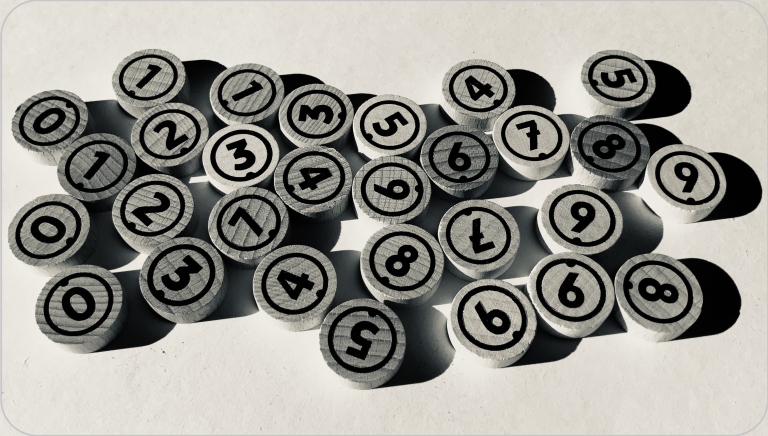
Stones
Get NowThe basic set contains 30 stones and is intended (ideally) for activities of one student. Wooden stones (beech, hornbeam) have embossed numbers 0 – 9 (the game piece has a diameter of 19 mm and height of 6 mm) and each number is included three times in the set. The set of stones is stored in a cotton bag with a drawstring. The bag is printed with the name of the tool and a ring. We recommend writing a number or alphabetical order in the ring and pairing it with the list of students in the class so that each student is responsible for the bag's contents. This is particularly worthwhile if the tool moves from class to class. For functional work in class according to the methodology, we recommend ordering a "Class set" for 15 or 30 students.
You can also order the color of the stones. Just write the desired color of the stones in your order. The standard color is black, on request we will send blue, red, or red-black double-sided printed (SPIN variant).
Uses
Abaku stones are designed for both beginners and advanced learners. They are suitable for both individual and group use. Tips and suggestions for getting started with games and working with stones can be found in the Abaku Start / Stones methodology. Stones can be used for example for games in a desk for suggestions such as "create a number" or "Abaku sequences" or "logical sequences".
Why should you work with stones? Imagine you have to calculate an example in writing and you make
a mistake. There's nothing left but to strike everything out and start writing again. If there's a
scratch mark on the page - you already consider that a mistake even if the correct result is
written next to it. You would prefer to start writing on a new clean sheet of paper.
When counting with stones, you don't have to scratch anything out. All you need to do is simply replace
or move the wrong stone. But the best thing about stones is that they are solid, clearly graspable
numbers that a child can touch, pick up, hold in their hand, and make their own (build a relationship
with). If you hold such a number in your hand - it's easier to understand and place it where it belongs
or could belong. Or just play with it and consider what to do with it. That's why it belongs in the
hands of preschoolers and first graders.
Didactic note: The child's interest is more important than the result. Mistakes are an inevitable consequence of teaching arithmetic and should not be recorded or evaluated as errors.
Templates: 33 templates to download for beginners and advanced learners
The templates offer background guide surfaces for games, exercises and activities with stones. For a teacher who has become familiar with the Abaku methodology, there is no need to explain at first glance the obvious purpose of their possible use. We recommend that you print and laminate the templates, because the templates are suitable for every playful start to a lesson.
- "Magic squares" (on the internet you will find many nice instructions by typing "magic square" into a search engine. (for example Magic Squares)
- Logical and Abaku sequences
- Small and large grids for games according to your rules and row templates for exercises and tasks
- Abaku game - placing stones according to the rules of the Abaku game. Preparation for the game, which can be ordered separately with a paper or variable game board.
1. Sorting
The game is suitable for the youngest students. Each player has 1 - 3 sets of stones from 0 to 9.
Students work independently or in pairs. The task is to sort the stones. Correctly and as quickly
as possible. You can compete or just play. We can sort the stones into odd and even, or into rows
from the smallest to the largest number or vice versa from the largest to the smallest number. We
can try to create as many even numbers as possible (2, 4, 6, 22, 128,...) or odd numbers (1, 3, 7,
23, etc.). We can sort and name stones with zero at the end and name them (10 - ten, 20 - twenty,
2000 - two thousand, 2010 - two thousand ten, etc.), etc.
Time requirements for one game: The game lasts 5 – 10 minutes. The game can be scheduled at any time
during the class.
2. Triples
The game is suitable for more experienced students / who already know the principles of Abaku
numbers and are able to attach them to stones already lying down. Players gradually compose Abaku
equations on the table. Each player starts with (10 - 20 - 30) stones (1x0-9, 2x0-9, 3x0-9). In
their turn, they can attach a maximum of three stones (or 4 stones / depending on player
experience). We attach according to the rules of the board game. Stones are attached so that all
are part of one Abaku equation and are in one line horizontally or vertically. Whoever gets rid of
all their stones first - closes the game.
Time requirements for one game: The game takes approximately 10 minutes.
3. Offer
The game is suitable for more experienced students / who already know the principles of Abaku
numbers and are able to attach them to stones already lying down. A game for 4 players. Played
with 80 - 100 stones. Each player draws 5 stones. From the bag we randomly select one stone
"nabika" and place it in the center of the table. The first player tries to make an equation from
their stones and the "nabika" with at least two stones (if they already know powers). If they do,
they draw the missing stones up to 5 and place a new "nabika" from the bag on the table. If they
cannot or cannot do so, they say pass and draw another "nabika" from the bag to the "nabika" on
the table. The next player can use one or both "nabikas". If they want to use both, both must be
part of a single laid-out equation, which must contain at least one other player's stone. Whether
they use one or both nabikas - again after finishing their turn they draw stones and place one
"nabika" from the bag on the table. If they could not play, they say pass and draw a third one to
the two nabikas.
The game continues to the end. The player with the most laid-out equations wins. Players write down
the number of equations laid out at the end of each turn.
Time requirements for one game: The game takes approximately 10 - 15 minutes.
4. Combo
The game is suitable for more experienced students / who already know the principles of Abaku
numbers and are able to attach them to stones already lying down. A game for 4 players. Played
with 100 stones. Combo is a combination of numbers that contains three or more equations. Players
draw 10 stones each. At the start signal (if they can) each player lays out one or more combos on
the table. They can also lay them out in a cross so that a certain stone could be used in two
combos. The time for a turn is approximately 1-2 minutes.
They mutually check and record who laid out how many equations. Stones from combos are put aside -
unused stones are thrown back into the bag and the next round is drawn. This continues until the bag
is exhausted / if the contents of the bag do not allow each player to have at least 5 stones for the
game - the game ends. (it's rare to use all the stones from the bag)
The player who laid out the most combos wins and thus earns the title Combo Master:).
Time requirements for one game: The game takes approximately 10 - 15 minutes.
5. SPIN Game Variants
A game for two players or two teams using SPIN stones (double-sided printed). Players place equations on the table or board in their color and at the same time flip the old stones on the surface already lying there into their color, which they used in their equations during their turn. At the end of the games, whoever has more stones in their color wins / or at the end of the game, whoever wins after adding the number of stones in their color to the final result, wins more points.
X. Your Game
A game that you play with stones with students, that students very much enjoy and is not described here and you want to tell others about it. Join the team of methodology creators and please send your suggestions to info@abaku.org. We will test it and be happy to share it here.
Tool Description
Equipment - we supply the "hand" set for each student in a drawstring bag and together in a bag or
portable backpack.
We manufacture the tools in Bohemia and they are made to be portable and serve in schools for years.
The basic "hand" set contains 30 original tokens with digits 0 – 9
Technical specifications: Supplied in a cotton bag with printing.
Product: beech, oak, hornbeam wood
Stone size: 19 mm
Print: digits with color are embossed into the surface.
Surface: matte | Also available with double-sided or color printing. Lifespan 3 - 10 years