Abaku Origins
Vladimír Tesař
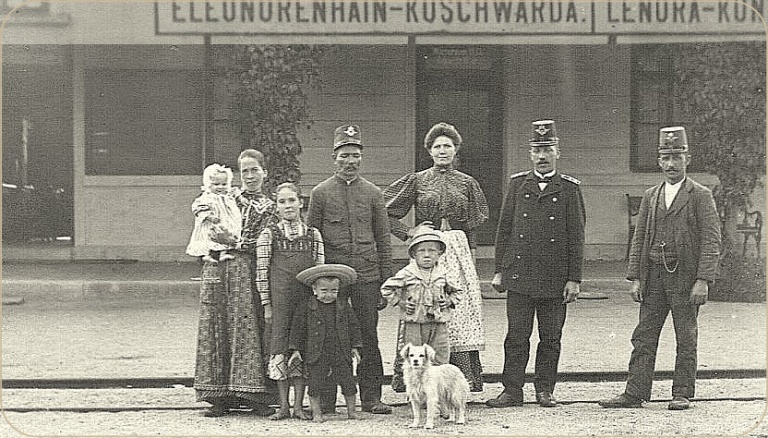
As young ten-year-old schoolboys, my friend and I were sent by our parents during winter smogs to an old aunt – a childless friend of my grandmother – in Šumava (somewhere near Lenora) to "recover." Of course, it wasn’t a vacation, and every day we boarded a small train at a tiny station heading to a small school in a central village.
Then it started snowing, and it snowed for seven days, causing a disaster and a calamity, and the train stopped running. We were thus stuck at the aunt’s cottage for about ten days, and on the first day, we started misbehaving so much that the aunt said enough and that she would give us a school like we had never seen before.
She said she would handle dictations herself, but she was not good at math, so she left for the village, saying she would be back soon. She returned silently, and with her came a very old man whom we later learned was called "Pokojskej" in the village. This nickname came from his habit of waving his hand and saying, "Leave me in peace!" whenever someone asked him for something.
Old Pokojskej lived alone at the edge of the village and rarely interacted with people. The aunt brought him back, saying, "He will teach you to count," and he looked at us sharply and mumbled something about how much one and one is.
We both shouted, "Two," and he smirked, muttered something about cracked eggs, looked at the aunt, turned to leave, and over his shoulder said, "Go to bed now; tomorrow, I’ll bring you an Abacus."
Abacus? We barely slept that night, wondering what it was. In the morning, we stared into our cups, seeing the reflection of the kitchen ceiling – even the aunt didn’t know what an abacus was, and I thought to myself it might be a giant whip.
And it was!
The door opened without a knock, and he stood there, measuring us from under his brows. Then he came to the table, rummaged in the pocket of his old jacket, and poured out a pile of wooden blocks with numbers drawn on them. "Abacus," he announced, pushed a chair aside, and sat down with us. The aunt turned from the sink, placed a coffee in front of him, and left us alone with old Pokojskej and the Abacus.
And so it began. And how did it end? Well, when we finally got back to class after the calamity, we could calculate like lightning, and it stayed with us.
Seven days of training and playing with old Pokojskej and his blocks were enough. What did he teach us? He taught us to focus only on numbers and imagine the arithmetic signs. Then he revealed some funny tricks, which he told us never to share at school (like how zero can double the result or that all digits have their own little characters: 9 – Devíťuka, 8 – Osmíčka, 7 – Sedmulu, 6 – Šouru, 5 – Pulce, 4 – Čiříka, 3 – Trťku, 2 – Zajda, 1 – Čudla, and 0 – Bublina).
We never went back to the old aunt after that winter with the calamity.
Years later, as adults, my friend and I reminisced about Pokojskej over a drink and decided to visit the place after all those years. We figured that to a child, any adult seems ancient, but in reality, he might have been just a scruffy thirty-something. We found no one, only the daughter of the old aunt’s neighbor, who remembered the aunt and had some vague knowledge of old Pokojskej but knew nothing else.
So we decided to recreate old Pokojskej’s game for other children and adults.
And we really did it, naming the game Abaku so that the "s" at the end wouldn’t hiss so much.
We wish you Good Luck.