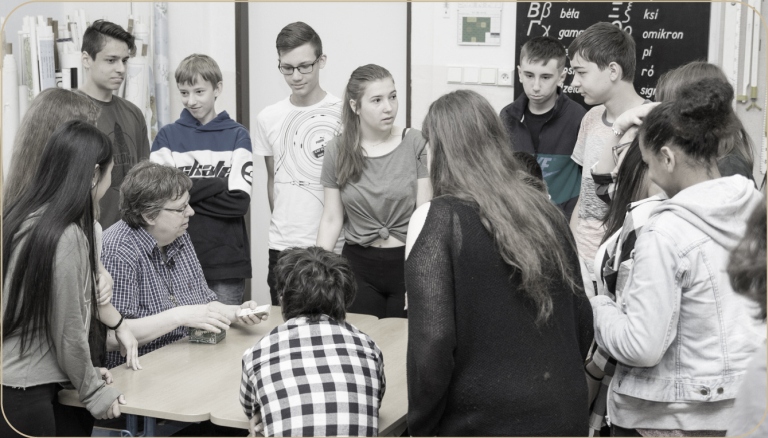
Plusville
Alena Vávrová
All suggestions are connected to a fictional town – the world of Plusville. We find here places where we commonly encounter numbers. In Plusville, everything is as we know it from our world – except all the numbers in it are Abaku numbers. We are sure that with children you will be able to find more than you find in this inspiration.
Houses in Plusville
Topic: Powers and roots in Abaku examples.
Goal (expected output): Apply repeated multiplication to power calculation. Create pairs of numbers
and their powers and see them in numbers.
Typical age group: 10 years old (3rd grade) and older.
Before you start walking through the streets of Plusville, look in the Abaku Chains exercise at the
Powers section. In it, the very concept of powers and roots is introduced using Abaku. This is especially
appropriate in the case of younger children who have not yet encountered this concept.
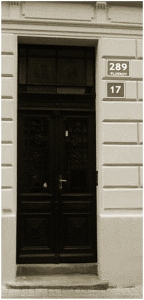
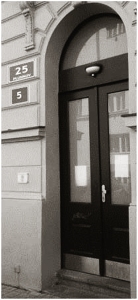
In Plusville, like everywhere else, houses have descriptive numbers (red) and address numbers
(blue). Address numbers are in order in the direction from the central square or from the river
and along its direction. In Plusville, the river hasn't started flowing yet, so it's from the
center, and if we go in the direction of increasing numbers, the houses on the left have odd
address numbers and on the right even numbers.
But it's Plusville, so the descriptive numbers are the squares of the address numbers. Go through examples
of entrance doors on one street in Plusville.
* Verify by calculation that the houses are really from Plusville, that is, that the "red" number is
the square of the "blue" number. Think about whether the same numbers can appear on one street. If
some number appears red on one house and blue on another, what will be the corresponding numbers?
For reference: For example, 4 – 16 and 16 – 256 or 3 – 9 and 9 – 81. * Use the little houses on the
street (print the working sheet Town for children) and fill in both the descriptive
and address number for each house. Create a table of numbers and their squares.
* Make sure to create a table together with powers of numbers 1-10; tackle the second according to
the situation. Sometimes children react enthusiastically and calculate the next row themselves
(and even more rows). Don't give them a ready-made table; it's more meaningful when they create it
themselves.
* Use the Town again and fill in only one
number (descriptive or address) for each house and let the children fill in the other number. Keep
the numbering of houses on the street, that is, next to each other are either houses with odd
address numbers, or with even numbers.
* Search for nice relationships among the numbers and their powers. Notice what digits the squares
end with and what digits do not appear in the units place of squares.
Did you know:
… house numbering was legalized during the reign of Maria Theresa in 1770?
… churches, chapels and uninhabited towers have not been numbered since the time of Maria Theresa?
… in most of Europe, houses have only one numbering, which is usually similar to the Czech address
numbers?
… in town squares, numbers are usually assigned sequentially around the square in a clockwise direction?
… descriptive number is a requirement for registration in the real estate register?
… on embankments, there is only one row of houses (that is, only odd or only even numbers)?
Transportation in Plusville
Topic: Searching for examples "hidden" in car license plates. Practicing mathematical operations
in the range up to twenty with crossing over tens. Practicing the multiplication table.
Goal (expected output): Teach children to "see" an example in a group of numbers without written symbols,
search for interesting combinations and notice beautiful arrangements of numbers. Practice examples
with the multiplication table, find combinations that hide other examples.
Typical age group: 7 years old (end of 1st grade) for the first part, 9 years old for the second part.
Instructions: We motivate children by telling them about the town of Plusville, where people play with
numbers, search for and find many interesting and beautiful things in them. License plates on cars
are such that their numbers form an example in the form "number – arithmetic operation symbol – number
– equals sign – result number" (always in that order).
Example: The license plate is 1073, the hidden example is 10 − 7 = 3.
* Start showing the pictures PR Car 1. Go
through each car with the children, let them choose their favorite colors and only then search for
examples together and write them all down. Discover that some cars have two hidden examples in the
plate.
Before you start this activity with children, go through all the cars yourself and find all the examples.
They are all addition and subtraction up to twenty. All the little cars in the parking lot are from
Plusville, so there are examples in all the plates.
For reference:
PR Car 1
1st row: 2 + 9 = 11, 4 + 9 = 13, 6 + 7 = 13, 7 + 8 = 15
2nd row: 5 + 6 = 11, 3 + 8 = 11, 8 + 4 = 12, 9 + 5 = 14 and 5 − 1 = 4
3rd row: 10 − 7 = 3, 14 − 7 = 7, 16 − 8 = 8, 12 − 3 = 9 and 1 + 2 = 3
4th row: 15 − 6 = 9 and 1 + 5 = 6, 4 + 6 = 10, 14 − 5 = 9 and 1 + 4 = 5, 18 − 9 = 9 and 1 + 8 = 9
5th row: 4 + 7 = 11, 16 − 7 = 9 and 1 + 6 = 7, 12 − 6 = 6, 10 − 5 = 5
Pictures PR Car 2 and PR Car 3 contain cars where multiplication (PR Car 2) and division (PR Car 3) were used to build the number on the plate. Work with children together, search for examples and write them down correctly with all symbols.
PR Car 2
1st column: 2nd column
6 · 8 = 48 2 · 6 = 12
9 · 5 = 45 and 9 − 5 = 4 5 · 7 = 35
7 · 2 = 14 3 · 9 = 27 and 9 − 2 = 7
3 · 6 = 18 8 · 4 = 32
4 · 5 = 20 6 · 7 = 42
PR Car 3
1st column: 2nd column
63 : 7 = 9 21 : 7 = 3
36 : 4 = 9 16 : 4 = 4
42 : 7 = 6 28 : 4 = 7
72 : 8 = 9 81 : 9 = 9 and 8 − 1 = 9 and 1 · 9 = 9
54 : 6 = 9 24 : 3 = 8
* Distribute working sheets Car 1 to children. Children write down the example hidden in the plate on the car. Check those who are done to see if they really found all the examples. Those are of course not put together from all digits.
For reference:
Car 1
1st row: 9 + 2 = 11 and 2 − 1 = 1, 8 + 7 = 15 and 8 − 7 = 1, 4 + 8 = 12, 8 + 5 = 13, 18 − 9 = 9
and 1 + 8 = 9
2nd row: 7 + 6 = 13 and 7 − 6 = 1, 9 + 8 = 17 and 9 − 8 = 1, 2 + 8 = 10, 4 + 9 = 13, 15 − 8 = 7
3rd row: 9 + 6 = 15 and 6 − 1 = 5, 12 − 5 = 7 and 2 + 5 = 7, 3 + 9 = 12, 13 − 4 = 9 and 1 + 3 = 4,
16 − 7 = 9 and 1 + 6 = 7
4th row: 9 + 7 = 16 and 7 − 1 = 6, 13 − 5 = 8 and 3 + 5 = 8, 6 + 5 = 11 and 6 − 5 = 1, 10 − 9 = 1,
17 − 8 = 9 and 1 + 7 = 8
* Distribute working sheets Car 2 to children. Children write down the examples hidden in the plate for each car. Check those who are done to see if they really found all the examples. Those are of course not put together from all digits.
For reference:
Car 2
1st row: 42 : 6 = 7 and 4 + 2 = 6, 54 : 9 = 6 and 5 + 4 = 9, 81 : 9 = 9 and 8 + 1 = 9 and 1 · 9 =
9
2nd row: 7 · 3 = 21 and 3 − 2 = 1, 24 : 8 = 3 and 2 · 4 = 8, 12 : 2 = 6 and 1 · 2 = 2
3rd row: 45 : 9 = 5 and 4 + 5 = 9, 32 : 4 = 8 and 2 · 4 = 8, 3 · 9 = 27 and 9 − 2 = 7
4th row: 24 : 4 = 6 and 2 + 4 = 6, 36 : 9 = 4 and 3 + 6 = 9, 7 · 9 = 63 and 9 − 6 = 3
5th row: 8 · 9 = 72 and 9 − 7 = 2, 16 : 2 = 8
* Car Blank are working sheets with cars
without plates. Use them so children can invent and create plates for Plusville cars themselves.
Let children choose the most beautiful plate, and most importantly, explain why it is the most
beautiful to them. Watch their reasoning and praise them.
* Look at the Problem Tasks section for the License Plates exercise.
My Phone
Topic: Combinations of examples from your own phone number.
Goal (expected output): Teach children to "see" an example in a group of numbers without written symbols.
Typical age group: 3rd grade and older.
Instructions: Perhaps everyone has their assigned nine-digit number – their mobile phone number. Let's
play with those numbers. Everyone writes down their phone number and searches for hidden examples in
it. They don't change the order of digits; they search as the number is given. For example, 720 827
512 contains the example 7 + 5 = 12.
Children will probably not find many examples, and some won't find any.
* Project Phone on the board and sort the
phone numbers on each phone according to the number of examples. It's interesting how many
children don't know their own phone number. Therefore, it is appropriate to agree that for this
lesson children will have their phones and can search for other numbers (parents, friends, etc.).
* You can print and distribute the worksheet with phones (Phone) to children, but they can just as well work on blank paper. They write down their phone number
and create examples from the given nine digits. How many do they discover? They write a friend's
number on another phone and create combinations again. Let children compare their combinations and
search for the phone with the most combinations.
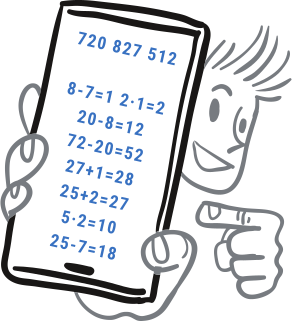
The image is mainly for your understanding; it definitely doesn't list all possible examples.
Fountain in Plusville / Fountain 1
Topic: Combinations of numbers.
Goal (expected output): Combines numbers to create an Abaku number.
Typical age group: No limitation.
Instructions:
In Plusville, they installed a new fountain in Cartesian Product Square. The installed Abaku number
changes into more and more Abaku numbers. No number repeats on one stream of water. The image shows
less than half its potential from the given starting spring 824. Can you open the spring fully?
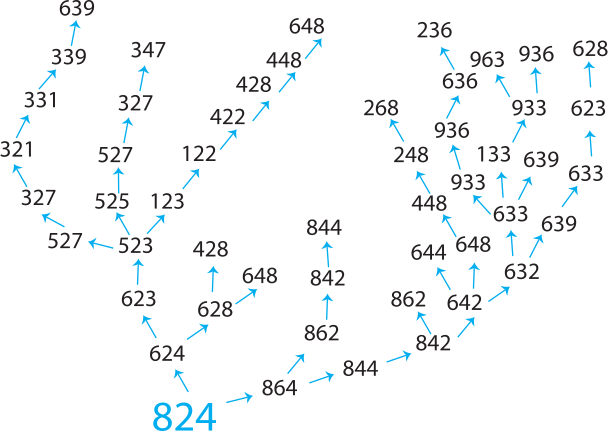
* We choose a basic Abaku number. From it, we create more Abaku numbers by changing one digit. We
initially don't leave the basic choice to the children, because not every number is suitable. For
example, from the number 347, no stream of Abaku numbers will flow.
Suitable are numbers allowing a transition to the multiplication table up to ten, like 8:2=4 or 9:3=3
or 6:2=3 in the example. Specifically: 824, 624, 523, 623, 369 and their suitable permutations.
Sometimes children prefer a "waterfall" - we place the starting number at the top edge of paper or
the board and the stream of numbers heads downward. The activity at first sight is not suitable for
first graders, because you can't get by without crossing into/from the multiplication table. I believe,
however, that it's not a problem to show children these simple examples.
For independent work (preferably in pairs or small groups), you can use regular blank paper or multiply
a template from the methodology worksheets - Fountain 1.
What if... / Note: Most of the tasks listed below are intended for older students, because finding solutions to some problems requires setting up and solving equations. However, this does not mean that fifth graders will not be able to crack some of the presented questions together.
What if / See the Videos / Changing Digits section. Topic: Adjusting "normal"
numbers to Abaku numbers.
Goal (expected output): Teach children to "see" an example in a group of numbers without written symbols.
Typical age group: No limitation.
Instructions: Write the number 1276 on the board. It's
not Abaku, but it would only take changing one digit to make it Abaku. Which digit and how? Let
the children suggest and write down solutions.
(For reference: 1266, 1226, 1275, 4276, 1376).
* Write another number. You could write seemingly endless assignments, but if we want the task to have
multiple solutions, there won't be that many. These are primarily numbers aimed at the sum of single-digit
numbers crossing ten (or their suitable permutations) and allowing a suitable multiple of two, three
in the adjustment.
For example: 1056, 1235, 8312, 1869, etc.
If we only allow addition and subtraction, the activity is suitable even for the youngest students.
With first graders, we choose the option of manipulating individual digits instead of writing.
* Let children come up with their own assignments and evaluate numbers with many solutions. Make sure
they change exactly one digit and don't change the order of digits. Of course, you can change the rules
next time, as you wish, just make sure that clearly given rules at the beginning don't change during
the lesson and are kept consistent.
For reference:
1056 – 1055, 1046, 1156, 3056, 1052
1235 – 1234, 1239, 1535, 1275
8312 – 8412, 8311, 8512 (8 cubed is 512), 9312
1869 – 1899, 1829, 1863, 1569
* Connect with the Plusville Fountain activity, where individual digits also change.
Abaku Date
Topic: Date with hidden examples.
Goal (expected output): Based on a given pattern, systematically find other variants.
Typical age group: 5th grade and above.
Instructions: In Plusville, in addition to the usual national holidays and days off, they celebrate
when there's a beautiful date.
17.3.2014
For example, in 2014 it was March 17th. There were big celebrations, even schools were closed.
Find more days with beautiful dates when they will have holidays and days off in Plusville. First,
find out why this particular date is beautiful from Plusville's perspective. The date March 17,
2014 contains 17 + 3 = 20 and 17 − 3 = 14.
* Find other corresponding groups of numbers.
Let's try a general expression a + b = 20 for the current 21st century and then a − b = c. What are
the conditions for the individual variables? We move in the domain of natural numbers a ≤ 31, b ≤ 12,
variable c is indeed ≤ 99, but that's just for completeness; when actually searching, this information
won't help us.
Let's take variable b as the basis (there are fewer of them) and create a table:
| b | a=20-b | c=a-b | Resulting date a.b.20c |
|---|---|---|---|
Don't be afraid to reach the table with younger children (5th grade) and fill it out together.
Notice that the last rows in the table are outside the domain of natural numbers.
| b | a=20-b | c=a-b | Resulting date a.b.20c |
|---|---|---|---|
| 1 | 19 | 18 | 19.01.2018 |
| 2 | 18 | 16 | 18.02.2016 |
| 3 | 17 | 14 | 17.03.2014 |
| 4 | 16 | 12 | 16.04.2012 |
| 5 | 15 | 8 | 15.05.2010 |
| 6 | 14 | 6 | 14.06.2008 |
| 7 | 13 | 4 | 13.07.2006 |
| 8 | 12 | 2 | 12.08.2004 |
| 9 | 11 | 0 | 11.09.2002 |
| 10 | 10 | x | 10.10.2000 |
| 11 | 9 | x | x |
| 12 | 8 | x | x |
Won't it be a disappointment for children that such a date will only occur twice more? Start
looking for other beautiful dates that could be an occasion to celebrate. For example: Date
5.4.2001 (5 · 4 = 20 and 5 − 4 = 1) is beautiful, but it's already passed.
Date 17.3.2051 (17 + 3 = 20 and 17 · 3 = 51) corresponds to the first two columns and c = a · b etc.
Focus on the current calendar year and search for the most beautiful Abaku date this year. Acknowledge
each proposal from children that they justify. Go back to the past and search for which days were holidays
in Plusville.
Always Different, Yet the Same
Topic: Different examples from the same arrangement of digits.
Goal (expected output): Thinks about various permutations of digits.
Typical age group: 14 years old (8th grade).
Framework Educational Plan outputs:
Period 2: Uses commutativity and associativity of addition and multiplication in mental and written
calculations, solves and creates tasks where they apply learned arithmetic operations across natural
numbers, solves simple practical word problems and problems whose solutions are largely independent
of usual school mathematics procedures and algorithms.
Period 3: Uses squares and square roots in calculations, formulates and solves real situations using
equations and their systems, analyzes and solves simple problems, uses logical reasoning and combinatorial
judgment when solving tasks and problems, finds various solutions to presented or examined situations.
Instructions: We know about Plusville's love of interesting numbers. They have a particular
weakness for numbers that hide different examples in them with the same arrangement of digits. The
most well-known of such numbers is 224, where 2 + 2 = 4 or 2 · 2 = 4 (and of course 422 goes with
it). Given the Abaku notation of powers, another number is 981 as 9 − 8 = 1 or 9² = 81. These are
the only three-digit numbers with this property.
* Can you find a four-digit number? I don't know of one, but if you discover one, please let me know.
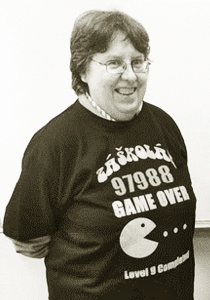
For multi-digit numbers, this property appears more frequently. Plusville residents call these
numbers super-numbers and wear them, for example, on T-shirts, believing that such a number brings
luck. One of those five-digit numbers is 12111, where 12 − 1 = 11 or 121 is 11². The number 97988
is also a super-number, because 97 − 9 = 88 and 9 + 79 = 88.
Find other numbers of this type, that is, one addition example and one subtraction example from the
same arrangement of five digits.
For reference: Giving only one number won't reveal what the next one should be. Therefore, it is appropriate
to give one more number. Look at the final solution and simply choose one based on your preferences.
Even younger children only need these two numbers to start thinking about the same ending pair of digits,
and through trial and error will find other numbers.
For older children, we try a general expression: Start with 224 and write it as a+a=a.a. The equation
has two solutions (a=0 and the other is a=2). Zero is not a natural number, two is the solution we're
looking for, confirming what we know, and at the same time proving that no other number has such a
property.
Let's try to express a super-number generally from a shirt: 10a + b − c = a + 10b + c, and we rearrange
the expression to 9(a − b) = 2c. We realize that a > b and the difference a − b must be even. We create
a table for all mutual values of a, b and calculate c.
| a/b | 1 | 2 | 3 | 4 | 5 | 6 | 7 | 8 |
|---|---|---|---|---|---|---|---|---|
| 2 | x | |||||||
| 3 | 9 | x | 9 | |||||
| 4 | x | 9 | x | |||||
| 5 | x | x | 9 | x | ||||
| 6 | x | x | x | 9 | x | |||
| 7 | x | x | x | x | 9 | x | ||
| 8 | x | x | x | x | x | 9 | x | |
| 9 | x | x | x | x | x | x | 9 | x |
For each value of a, only one value of b can be found such that c is single-digit. Now we can assemble ordered triples abc and add the last pair of digits:
319 22
429 33
539 44
649 55
759 66
869 77
979 88
So we found seven super-numbers. There are definitely more, though not of this kind...
License Plates
Topic: Commutative law in multiplication and division examples, searching for beautiful Abaku
numbers.
Goal (expected output): Practice examples with the multiplication table, find combinations that hide
other examples. Teach children to "see" an example in a group of numbers without written symbols, search
for interesting combinations and notice beautiful arrangements of numbers. Developing logical reasoning,
estimation and subsequent finding of the exact result. Systematic work, finding different procedures.
Typical age group: 10 years old (3rd, 4th grade) and older.
Instructions: In Plusville, everyone has license plates on their cars such that they hide examples
in them.
And now everyone is getting new plates. Letters indicating the town are missing from them, but they
still meet the conditions for Plusville. Everyone can adjust their current plate by rearranging the
digits. And of course, everyone is interested in a plate that has more than one example in it. Help
Plusville residents improve their car plates.
We assume that children are already familiar with the principle of Abaku plates on cars. They know
that some examples can contain others. Lead the children to realize that multiplication is commutative,
that is, by swapping the factors, the result doesn't change. Similarly, we can exchange the divisor
and quotient in division.
But with Abaku examples, some variants are more advantageous in that the number then contains another
example.
For example: 4728 contains only one example, which is 4 · 7 = 28. When I swap the factors to 7428,
the basic example is essentially the same, that is, 7 · 4 = 28, but another example appears, namely
4 · 2 = 8.
In both previous activities, you may have encountered the question, how many cars with different
license plates could there actually be in Plusville. In other words: * How many cars could maximum
be in Plusville so that each has its own license plate? Let's recall that the numbers on the
plates are four-digit and zero can only be part of the number (for example, 20, 70, etc.). Under
these conditions, how many cars can be registered in Plusville?
* Have children make an estimate first. Let each write down their guess, maybe even secretly so no
one sees it. And start finding out the actual number together.
* How many are all four-digit numbers, and thus different numbers on license plates? On regular cars,
zeros at the beginning are also used, so that's a total of 10,000 numbers.
* How many of these are Abaku numbers, thus suitable for car license plates in Plusville? Let children
suggest how to find out. Their first suggestions will usually be chaotic.
This is a table with the multiplication table written as Abaku numbers; children already know this
way of writing from previous activities.
* Compile it together and by all means add multiplication by one, which is omitted in this table.
* Cross out numbers (examples) that don't meet the conditions, that is, are not four digits (so the multiplication table of one was already omitted from the table). 58 examples remained.
* Review the table (notice the beautiful pair of numbers below each other: 8324 and 8432). * Show that each number has its "little
brother", such as the one marked in red. Only numbers on the diagonal are unique (have you talked
about powers?).
How do we find more numbers? * Lead children to realize that it's unnecessary to create a division
table, that for each of the 58 examples found in the previous table, there is exactly one division
example. So we have another 58 examples. Done?
Does anyone think of another way to create four-digit Abaku numbers? It will definitely depend on whether
and with what time interval you did Abaku cars. Of course, we'll use addition and subtraction. The
only way to get a four-digit Abaku number from addition is to take and add two single-digit numbers
so that the result is two-digit. * Let children derive that the largest possible result is 18 and why
not 19.
From each set of four in the table, you can get four examples, but except for those colored, where
there are only two options. Two addition examples, two subtraction examples. A similar situation
as in the previous multiplication table. Did you get 90? So in total there are all four-digit
Abaku numbers suitable for car license plates in Plusville: 2 · 58 + 90 = 206.
In individual steps of derivation, children can refine their estimates.
The table with addition examples can also be written in the same way as the multiplication table, that
is, by listing all options in the required range and its gradual reduction:
There are 45 uncrossed numbers in the table, and the corresponding subtraction table has 45 as
well. It came out the same!
* Check the original estimates and think together about why they were (or weren't) so different. If
children naturally work with powers already, they will definitely come up with a suggestion to create
a number for a license plate using powers. These are the numbers 5125 and 1255, 6216 and 2166, 7343
and 3437, 8512 and 5128, 9729 and 7299. These are cubed powers and cube roots of numbers from 5 to
9; surprisingly, squares are two- and three-digit in Abaku notation and then jump directly to five-digit.
Plusville introduced license plates (3 digits) for single-track vehicles.
* Ask the same question as in the previous activity: How many vehicles (bicycles and motorcycles) can
be registered with different plates? Proceed the same way as in the previous case. Will someone think
of using the already finished tables and cross out from them? Be careful in the last step; if you count
power examples, those are squares (416, 525, 636, 749, 864, 951) and cubes (327, 464).
* Propose solutions to the situation in Plusville if more cars need to be registered. Real plate inspiration
is obvious. Evaluate whether it's better to add letters or extend the plates to five digits. It's ideal
when you have results from three- and four-digit plates.
What portion of regular license plates do Plusville cars represent on the road? Use ratios and percentages to express it so children have a sufficient understanding.
For reference: 216 out of 10,000 are about 2%, so out of a hundred cars, two could be from Plusville. How long will it take before 100 cars pass by the school? (And you have environmental education – human activities and environmental problems.)