Kindergarten is School
Ondřej Čavojský
For preschool-age children, motivation is most important. Like everyone else, preschool children need to know why they are doing a particular activity and that it has some meaning. It is important to engage them so that they complete it successfully. Only then can they become aware of whether their solution was successful and develop their ability to generalize the gained experience for other tasks (the effort to create rules).
It is therefore advisable to always name activities attractively and present them appropriately to children. It does not matter that they have done a particular activity before, because with new motivation it will seem like a new activity to them.
Take all activities here as shared educational practice that has been successfully practiced
and can serve as good inspiration or stimulus for you. If you want to start safely and with
certainty - you will need materials - we will be happy if you use ours, but you can just as
well make them yourself or use other number cards or number tokens.
The Abaku method is a method of teaching numbers. But why teach it when we can experience it?
I. CARDS
How to use cards?
I want to start
Preschool-age children can usually count to ten, but they still have a problem assigning a
value to a specific number. For the beginning, it is good for children to assign digits on
cards to some predetermined representatives, such as domino cards or pea balls. This is about
connecting a specific number with a digit.
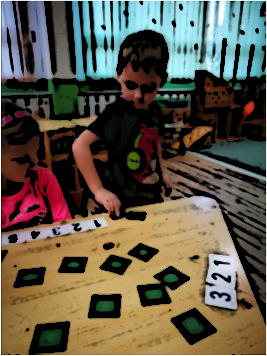
When introducing Abaku cards, it is appropriate to choose a game they already know. For example,
an alternative to the memory game. Children here simply get to know the display of numbers on the
cards in a group.
I'm getting a little oriented
Once children begin to orient themselves in numbers representing quantities, it is good to
raise the difficulty bar by comparing the values of cards. For the beginning, only cards from
one deck (0-5, 0-10).
When they no longer have trouble determining the value of a digit, they can play against each other,
for example, a trumps game.
I've mastered the basics
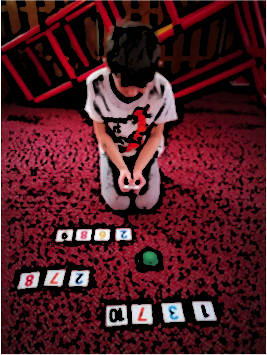
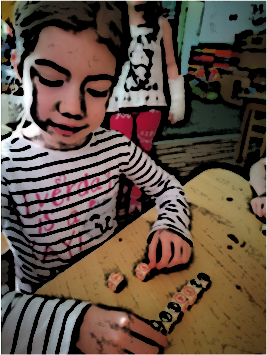
If children are oriented in the values of cards and in the number sequence, we can try to build simple examples from the cards with them. We will start with the decomposition of representatives into two groups, to which children assign the correct numbers. We point out to them the possibility of reversing groups (commutative principle). Some children will soon stop using representatives and start creating examples only with digits. Once a child has solidified the basics of building simple examples, they can move on to building Abaku rows. They build examples on cards as horizontal rows. We count from left to right.
I'm not afraid of challenges
If children no longer find it difficult to build simple examples and Abaku rows, we can increase the difficulty by determining which number the examples should start or end with.
Card Games
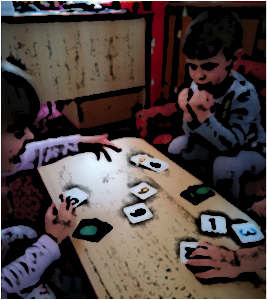
Maxeso – building pairs of consecutive numbers – creating a number sequence. It is advisable to play this game in a group of four children so that if a child wins, they do not leave the game, but help others at the table reach victory. The more skillful help the weaker ones anchor the number sequence, and even the weaker or less lucky player who only reveals cards, thereby hints to others, will not be left alone in the game.
Path – Building an Abaku row – trying to create the longest path from predetermined cards.
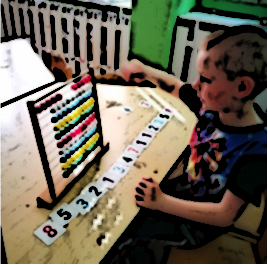
Snake – building an Abaku row – trying to create the longest snake from consecutive examples. The first two numbers form the head and are predetermined. Similarly, the last number is given - the end of the tail. This simplifies the control. Examples link to each other so that we only use the first two numbers to the left of the newly created result. We can thus involve both plus and minus. To solve examples, children can use an abacus, leading them to targeted verification of results.
Trumps – a game for two players – each player gets one deck of cards 0-10, shuffles it, turns it face down, turns over the top card in their deck and lays it in front of them. The player with the higher card wins the opponent's card. If the cards match, the players turn another card in the deck. The winner takes all the laid out cards.
Greater x Lesser (limited to one deck of cards 0-10) – random drawing of cards from a bag and placing them to the left (<) or right (%gt;) of the previously placed number. Supporting orientation in the number sequence up to ten.
Greater x Lesser (with multiple decks of cards) – the same rules as in the previous variant, but if a child draws a number they already have placed in a row, they create a new number sequence. At the end, there will be as many rows as the number of card decks received. The game can also be played in groups, e.g., which builds the longest row, uses the most cards, limit the game by time, etc.
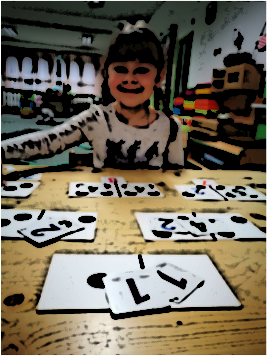
Determining Value – A simple activity for the beginning of the school year. Assigning digits to the number of dots on large domino cards.
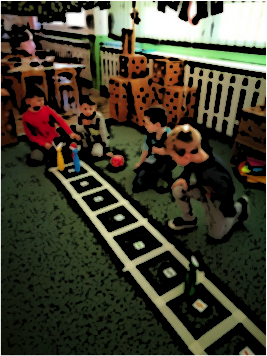
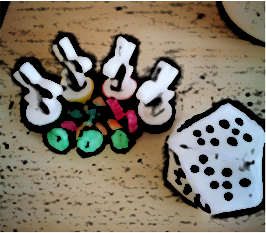
Rabbit and Fox – A game for multiple players. We create ten squares, on which we place cards with numbers from smallest to largest. For the game, we need rabbit figures according to the number of children, one fox figure, and a ten-sided die. The path for movement is divided into ten fields, with a number expressed in dots in each field (laminated cards, dominoes, pet bottle caps, etc.) Rabbits must hop to their burrow, where they can hide from the fox. The fox's task is to catch the rabbits. The rabbits start the game. The child rolls the die and moves to the field that came up on the die. After the rabbits have taken their turn, the player rolls for the fox. If the fox lands on a field where a rabbit is standing, the rabbit is caught and returns to the start. Players can jump forward and backward. The rabbit and fox move directly to the field they need to reach, the goal is to eliminate counting, i.e., to strengthen the relationship between the number and its representative. To improve the game, you can add various elements to individual fields that the rabbits must collect on their way to the burrow (for example, carrots, lettuce, etc.). The difficulty can be increased later by making the movement row not consist of dots in sequence (sequence 1-10), but children prepare it with a "skipping" pattern.
Rabbit the Gardener – a table version of the rabbit and fox game. Children roll a ten-sided die with dots marking the values on each side. Children move along a simple field where various types of vegetables that rabbits like are scattered. Children must collect as many types of vegetables as possible with their rabbit before they reach their burrow. Children can jump both forward (adding) and backward (subtracting).
II. DICE
How to use dice?
I want to start
Before each game with Abaku dice, it is necessary to verify that we have all the dice. Children verify this by building a number sequence 0-9 from the dice. Each child must have two dice of each color. The biggest problem for children is distinguishing between 9 and 6. To make it easier to learn, we tell children that six has a big belly and nine is tall and therefore has a big foot. The dot on the foot or on the belly tells us which number it is.
I'm getting a little oriented
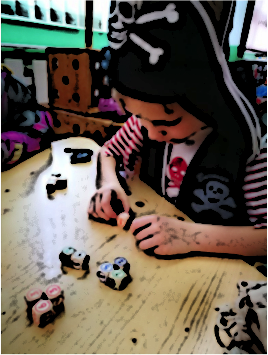
We let the children choose two dice they like, or we assign them colors and let them shake in their palms and throw them on the table. Before throwing the dice, we whisper the magic word "Abaku" into their palms. We do not re-roll the dice on the table and build an example from them. The result on the dice is always the sum or difference. The child finds the result on the remaining dice and places it between the dice face up, thus creating a simple pyramid.
I've mastered the basics
We already know how to create examples from the dice that came up. Now we try it the other way around. We take any one die in our hand and throw it on the table. For the number that came up, we try to create as many different examples as possible from the remaining dice (inverted pyramids).
I'm not afraid of challenges
For children who are already friends with the dice, we prepare a challenge. We try to build examples from all the dice. We shuffle all ten dice in our palms, whisper the magic word "Abaku" and throw the dice on the table. We select any four dice. We do not rearrange the dice in any way and lay them in a row next to each other. Between the dice facing down we place the results of the examples that the dice in the upper row give us. The result is the sum or difference. We proceed downward and create an Abaku bunch.
Dice Games
Checking Dice – happens whenever we open a bag of dice. Counting the dice and building them in ascending order or in descending order according to instructions into a number sequence. It is important to explain to children that the numbers on the die must always point to them with a dot. Six is thick and has a big belly, so it has a dot on the belly and nine lives on a high leg and therefore has a dot on the leg.
Pyramids – the most popular activity for children with dice – Take any two dice, shake them in your palms, whisper the magic word ABAKU into your palms and throw the dice on the floor. Place the correct Abaku result above the dice. The result is always the sum or difference of the numbers on the dice.
Bunches – The child takes all ten dice in their palms, shuffles them, whispers the magic word ABAKU into their palms and throws the dice on the table. From the pile, they remove four dice without re-rolling and place them next to each other. They always place the sum or difference of two dice below them. They continue until they can place the last die under two dice. If they cannot find a suitable number on the remaining, unplaced dice, they must exchange the die for another placed die with the same value.
V.I.P. Number – The child rolls any one die. They try to obtain the resulting number that came up on the die as the result of various mathematical operations with the other remaining dice. Children should use all the dice they have on the table.
III. STONES
How to use stones?
Where to start
I'm getting a little oriented
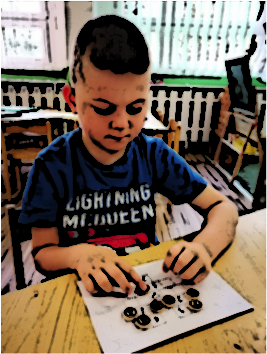
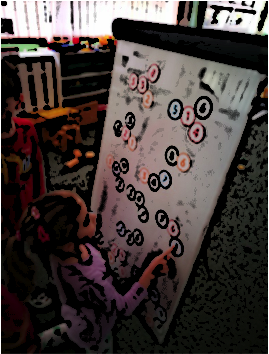
The game can also be played on a magnetic board with Magnum tokens.
I've mastered the basics
I'm not afraid of challenges
Games with Stones
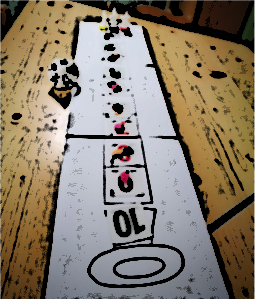
Maze – building an Abaku row from point A to point B. The essence of the game is the path from start to finish by filling in squares by creating examples. Children can take any stones they think they will need on their path. The maze has many dead ends and the rule is that if we start down a path, we don't take the stones back from it.
Dragon Counter – In the picture we have drawn any number of dragon heads (the more, the more different examples). Children must lead a "neck" from each head to the rest of the dragon's body. The neck is created from Abaku columns. The first two stones from each head are randomly drawn from a bag. The rest of the stones are freely available to children on the table.
Spider Web – we give children a pre-drawn spider web, in which there are gaps
(cracks) between individual points (numbers). The child must repair the web. They must fill
all the cracks to create a meaningful example.
The game can also be played on a magnetic board with Magnum tokens.
Coloring Pages – "Coloring" an image with the help of examples. Children receive a pre-created web with several numbers on it, and their task is to fill the web so that examples in triangles (pyramids) or rows or columns produce the correct result.
IV. MAGNETS / Magnum
How to use magnets?
I want to start
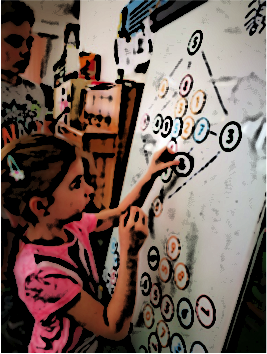
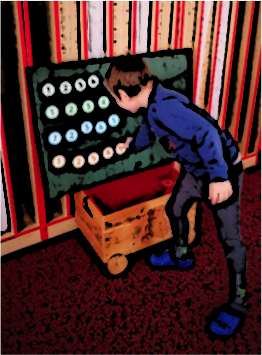
A simple activity for the beginning of the year or when we want to support children in solidifying the number sequence. We divide the children into groups by token color. Children build a number sequence from tokens on the board. Each child from the group can bring one token to the board or remove one token from it. Then they must run back to the start and be replaced in relay.
I'm getting a little oriented
From three tokens we can create simple examples. Good motivation is integration of emergency rescue system. Children usually already know the numbers for firefighters, police and emergency services. Now they can create numbers using examples. For example, a number for the mayor or perhaps the kindergarten. The more complex the number they come up with (example from more than three numbers), the more important the number is. For example, the number for the largest stuffed animal can be made from five tokens, for smaller ones from a smaller number or numbers with lower values, etc.
I've mastered the basics
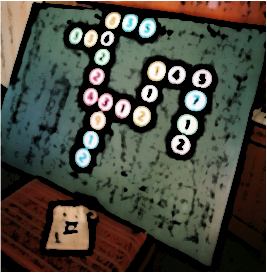
If children already manage to create horizontal and vertical number sequences, they can create simple Abaku crossings, where numbers must work out in all planes.
I'm not afraid of challenges
Once children can create Abaku crossings without major difficulty, they will start creating various images themselves. Other children will be happy to guess what their friend is trying to create from the examples. Then it is appropriate to give them some simple patterns that they can build, such as geometric shapes or simple animal drawings.
Relay – an activity suitable for the beginning of the school year. We divide children into groups by color (blue, black, red, green). Each group's task is to assemble an ascending (later descending) sequence from numbers 0-9 on the board as quickly as possible. It is important to explain to the children that the numbers must be placed with the dot facing down and what is the difference between six and nine. We scatter the cards on the floor and children compete in a relay to get them. They take a card from the floor that they think they need to place in the sequence and after placing it in the row, they return to their group. If someone thinks another player made a mistake, instead of searching, they can run to the board, place the wrong number back on the floor and return to their group. The group (groups) with all numbers correctly placed on the board wins.
Activities – by correctly building examples, we create an image on the board. This can be an object, animal, or letter. The game can also be played in a group where one group receives a pre-drawn assignment and must create it with the help of examples and another group guesses what it is while creating.
Phone Numbers – everyone knows that a combination of three numbers is needed to call the emergency line. In our city (Plusville) we want these numbers to make sense too. We create various three-member combinations with the children and think about who the number is for – cinema, library, etc. If tokens start running out, children themselves start connecting numbers in different ways, thereby creating multi-digit examples for the future ABAKU game. We can also motivate children to connect by saying that a longer number has its importance (for example, the mayor, the principal, etc.)
Crossings – children create examples from random numbers and group the numbers so that they create the sum or difference between the numbers.
V. BOARD GAME
The highest challenge for preschool-age children
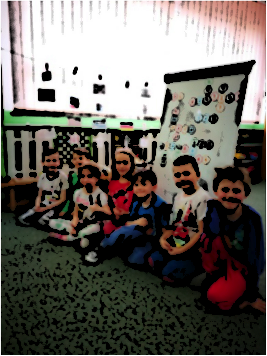
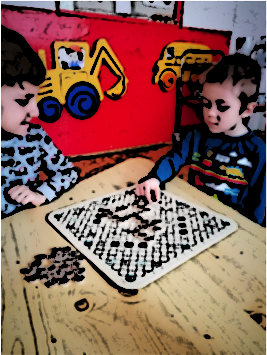
To actually play the game, we got with the best players until the end of the school year. Examples we created only using plus and minus (although some would be able to handle examples in the small multiplication table). Since example control and approval was entirely in the hands of the children, the rules were limited to addition and subtraction.