First grade porridge
Reading the history of teaching arithmetic is captivating and surprisingly educational even for
today's readers. In our lands, the teaching of arithmetic benefited most from the pedagogical work
of J. A. Comenius. In 1632, Comenius included arithmetic teaching alongside reading and writing as
an equivalent subject and wanted children to learn arithmetic already in elementary school.
Textbooks on "Arithmetic," which began to appear more and more frequently from that time, sought
the right content and proper structuring of the material so that an average child could master it.
The works "History of Mathematics Teaching" by Eva Pažourková and the book "Medieval Arithmetic
Algorithms" by Martina Bečvářová provide a good insight into this pedagogical and computational
journey.
(Note: Vladimír Tesař)
History of Mathematics Teaching in the Czech Lands / Eva Pažourková / 2007
Comenius on Mathematics Teaching / Jiří Mikulčák / 2010
Foundations of Arithmetic / Stanislav Vydra / 1806
Arithmetic Primer (Second) for Elementary Schools / Jan Kozák and Jan Roček / 1899
Arithmetic Primer (Third) for Elementary Schools / Jan Kozák and Jan Roček / 1917
Medieval Arithmetic Algorithms / Martina Bečvářová / 2001
History of Mathematics Crossroads / 1993 - 2020
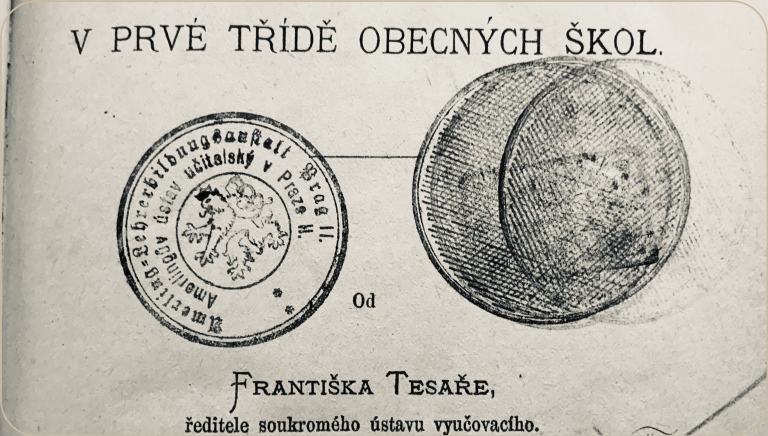
Visual Teaching (Arithmetic Exercises) in the First Grade of Elementary Schools / František Tesař / Published by Rohlíček and Sievers in Prague in 1873 by Theodor Mourek Publishing House.
The content of this ancient didactics represents the typical pattern of repetitive (drill)
methodology of arithmetic designed for the first grade of elementary school.
Individual arithmetic exercises are presented with brief and visual instructions and guidance. They
therefore presume a certain familiarity of the reader and user of the manual.
However, you will nowhere find the recommended number of repetitions necessary to memorize the material.
Therefore, we must assume the author's presupposition - that his readers (teachers) already knew the
correct measure - the number of repetitions.
I have found that in the pedagogical literature of that time, this measure is most often cited - only
under the pseudonym "Proper." With the understanding that it applies both to written (seen) and spoken
(thought) forms.
Directly from many generations of survivors who used this methodology (students), we have inherited
a requirement - the goal of this correct "proper" measure in the form of a saying: "Like the crack
of a whip," which was actually originally an old school term that described the speed of the teacher's
questions and the required speed in students' answers during oral arithmetic exams.
Instructions: For a child, addition is generally easier than subtraction - in the same way
multiplication is easier than division. Generally, subtraction is more difficult and division is
the most difficult.
It is important to thoroughly practice addition first before moving to subtraction. It is important
to thoroughly practice multiplication first before moving to division.
Arithmetic Exercise I. / Window
The teacher draws the outline of a window on the board.
T: Tell me, how many panes are in one wing? Count!
The student counts on the upper left wing 1, 2, 3.
T: Count in the lower half. We counted three panes above, below we counted 1, that makes 4, and one more, that makes 5. Now we will count the panes on the right upper wing. How many did we count here as well? Now let's add them all up! On the left side = 5, add one from the right wing - how much is that? And one more; how much is that? (This is how you count one by one up to 10.) The teacher then asks again: 3 panes and 1 is how much? and one more? 7 and 1? 2 and 1? …etc Then the teacher leads the adding of 2 panes.
T: 2 panes and 2; how much? 4 and 2? 6 and 2? 8 and 2? 1 and 2? 3 and 2? 5 and 2? 7 and 2? …etc
This counting is done on the board (picture), on an abacus, on small objects (in the desk). And finally, after practice, from memory.
Then (after fixation) comes adding three (only up to ten);
1 + 3 = 4 + 3 = 7 + 3 = 10
2 + 3 = 5 + 3 = 8
3 + 3 = 6 + 3 = 9
1 + 4 = 5 + 3 = 8
2 + 4 = 6 + 3 = 9
3 + 4 = 7 + 3 = 10
4 + 4 = 8
5 + 4 = 9
6 + 4 = 10
1 + 5 = 6 + 3 = 9
2 + 5 = 7 + 3 = 10
3 + 5 = 8
4 + 5 = 9
5 + 5 = 10
1 + 6 = 7 + 3 = 10
2 + 6 = 8
3 + 6 = 9
4 + 6 = 10
1 + 7 = 8
2 + 7 = 9
3 + 7 = 10
1 + 8 = 9
2 + 8 = 10
1 + 9 = 10
Each of these relationships must be first repeatedly shown and practiced when working (counting) with objects before we want memorization. The number of repetitions and fixation is governed by the needs of an average child.
Then comes subtraction. The teacher erases one of ten lines (on the board) and asks how many remain. Etc., analogous to the practice of addition. Students should learn to count quickly from 1 to 10 and from 10 to 1. Speed is achieved by repeated practice in various environments (board, paper, tools, unmarked blocks, sticks, tokens, stones).
Arithmetic Exercise II. / What is more?
Two mischievous boys threw a stone through a window. The first one broke 2 panes and the second one 1 pane. So what is more: 2 or 1? And what is less? By how much is 2 more than 1? And by how much is 1 less than 2?
We answer in terms of how many times.
How many times would you have to throw one stone to throw 2? So two is how many times 1? How many times 1 is 3? (continue this way up to ten).
By how much is it more?
By how much is 3 more than 2? 4 more than 3? 5 more than 4 and so on up to 10. By how much is 3 more than 1? 4 more than 2? 6 more than 4? Up to ten. By how much is 4 more than 1 up to ten.
We add 3 numbers. T: 1 + 1 + 1 how much? S: 3. T: Why? 1 + 2 + 1 how much? S: 4. T: 2 + 2 + 1? S: 5. T: 1 + 3 + 1? S: 5. T: 2 + 2 + 2? S: 6. T: 1 + 4 + 2? S: 7. T: 4 + 2 + 1? S: 7. T: 1 + 5 + 1? Continue this way up to 10.
Then comes dividing the number into two, into three, into four parts.
T: Tell me 3 in two parts. S: 2 + 1. T: Or differently? S: 1 + 2. T: 4! S: 2 + 2. T: Or? S: 3 + 1; 1 + 3. T: 5! S: 4 + 1; 3 + 2; 1 + 4; 2 + 3. T: 6! S: 3 + 3; 4 + 2; 5 + 1 or: 1 + 5; 2 + 4. T: 7! S: 6 + 1; 5 + 2; 4 + 3; 3 + 4; 2 + 5; 1 + 6. T: 8! S: 7 + 1; 6 + 2; 5 + 3; 4 + 4 etc. T: 9! S: 8 + 1 etc. T: 10! S: 9 + 1 etc.
We continue practicing. T: Tell me 3 in three parts! S: 1 + 1 + 1. T: 4? 1 + 2 + 1; 2 + 1 + 1 etc. up to 10.
Arithmetic Exercise III. / Subtracting
Subtracting / Again we draw a window (10 panes)
If one of these 10 panes broke, how many would remain? And if from 9 again 1? And from 8 again 1? (continue this way down to 0).
From 10 - 2; 8 - 2; 6 - 2…; How many would remain? (continue this way down to 0).
From 10 - 3; 7 - 3;…; How many remain? etc.
How many from how many broke?
4 from 10; 4 - 9; 4 - 8; 4 - 7; 4 - 6; 4 - 5; 4 - 4?
5 from 10; 5 - 9; 5 - 8; 5 - 7; 5 - 6; 5 - 5?
6 from 10; 6 - 9; 6 - 8; 6 - 7; 6 - 6?
Arithmetic Exercise IV. / Little Multiplication
T: 2 + 2 = 4; how many times did we add 2? S: Two times (2 x 2); T: So how much is 2 x 2? T: 2 + 2 + 2; is how much? S: 6. T: How many times did we add 2? S: 3 x 2. T: So how much is 3 x 2? T: 2 + 2 + 2 + 2; is how much? S: 8. T: How many times did we add 2? S: 4 x 2.
T: And how much did we count? How much = 4 x 2. S: 8
T: 2 + 2 + 2 + 2 + 2; is how much? S: 10. T: How many times did we add 2? S: 5 x 2. T: And how much did we count? How much is 5 x 2? S: 10
This is how students learn to calculate: 2 x 3; 3 x 3; 2 x 4; 2 x 5.
Now comes division. First, it is necessary to explain what division means, what is a part, what are equal and unequal parts, what is to halve, what is a half.
Arithmetic Exercise V. / Tens
What and how was done from 1 to 10, is now done in the other tens. T: You can already count to 10 and you will see how easily you will be able to count even more than 10. T: One window has 10 panes, look at how many the second one has! The second window also has 10. In two windows there are 2 x 10 windows (two tens), and when said quickly, it is called twenty. How many panes does the third window have? Three windows have three times ten (three tens), in short thirty panes. (we continue showing this way up to 40, 50 etc. 100.)
Children then state how many tens are in 20, 30, 40 up to 100.
Now comes counting from 10 to 20 in the following way:
Here are 10 (lines on the board - paper or stones, sticks, blocks, cards…), to which I add 1; so there are 10 and 1 or 1 and 10 . T: 1 and 10 / 10 and 1 is called eleven (one on ten), 2 and 10 / 10 and 2 = twelve, etc. up to 19.
Then the teacher names the numbers 11, 12 through 19. T: What number is beyond ten?
Then follows addition practice just like from 1 to 10. T: How much is 11 + 2; 12 + 2; 14 + 2; etc. 11 + 3; 12 + 3; 15 + 3; etc.
Arithmetic Exercise VI. / Adding
9 + 1 = 10
9 + 2 = 11
9 + 3 = 12
9 + 4 = 13
9 + 5 = 14
9 + 6 = 15
9 + 7 = 16
9 + 8 = 17
9 + 9 = 18
T: How much is 9 + 2? S: 11. Proof: 9 and 1 = 10 + 1 = 11
8 + 2 = 10
8 + 3 = 11
8 + 4 = 12
8 + 5 = 13
8 + 6 = 14
8 + 7 = 15
8 + 8 = 16
8 + 9 = 17
T: How much is 8 + 4? S: 12. T: Why? S: 8 + 2 = 10, 10 + 2 = 12
7 + 3 = 10
7 + 4 = 11 7 + (3 + 1) = 10 + 1 = 11
7 + 5 = 12
7 + 6 = 13
7 + 7 = 14
7 + 8 = 15
7 + 9 = 16
T: How much is 7 + 7? S: 7 + 7 = 14. T: Why? S: 7 + 3 = 10, 10 + 4 = 14
6 + 4 = 10
6 + 5 = 11
6 + 6 = 12
6 + 7 = 13
6 + 8 = 14
6 + 9 = 15
T: How much is 6 + 8? S: 6 + 8 = 14. T: Why? S: 6 + 4 = 10, 10 + 4 = 14
5 + 5 = 10
5 + 6 = 11
5 + 7 = 12
5 + 8 = 13
5 + 9 = 14
T: How much is 5 + 6? S: 5 + 6 = 11. T: Why? S: 5 + 5 = 10, 10 + 1 = 11
Arithmetic Exercise VII. / Subtracting
from
10 - 5 = 5
11 - 5 = 6
12 - 5 = 7
13 - 5 = 8
14 - 5 = 9
15 - 5 = 10
12 - 6 = 6
13 - 6 = 7
14 - 6 = 8
15 - 6 = 9
16 - 6 = 10
14 - 7 = 7
15 - 7 = 8
16 - 7 = 9
17 - 7 = 10
16 - 8 = 8
17 - 8 = 9
18 - 8 = 10
18 - 9 = 9
19 - 9 = 10
20 - 10 = 10
Arithmetic Exercise VIII. / Multiplying
6 x 2 = 12 2 x 6 = 12
7 x 2 = 14 2 x 7 = 14
8 x 2 = 16 2 x 8 = 16
9 x 2 = 18 2 x 9 = 18
10 x 2 = 20 2 x 10 = 20
4 x 3 = 12 3 x 4 = 12
5 x 3 = 15 3 x 5 = 15
6 x 3 = 18 3 x 6 = 18
3 x 4 = 12
4 x 4 = 16
5 x 4 = 20
3 x 5 = 15
4 x 5 = 20
2 x 6 = 12
3 x 6 = 18
2 x 7 = 14
2 x 8 = 16
2 x 9 = 18
2 x 10 = 20
Arithmetic Exercise IX. / Adding Units to 20, 30, 40 through 90
This exercise is not difficult, it is only necessary to alert students that tens are pronounced first and only then units. (20 + 1 or 1 + 20 = twenty one)
Arithmetic Exercise X. / Adding Units Across 20, 30, 40 through 90
The same as Exercise VI. Here the teacher teaches counting gradually across 20, 30, 40 through across 90. (19 + 6, 28 + 7, 34 + 7 etc.)
Arithmetic Exercise XI. / Adding Tens and Units
tens to tens
10 + 10; 20 + 20; 30 + 30.
40 + 10; etc 40 + 40.
50 + 10; 50 + 20; through 50 + 50.
adding tens and units to tens:
10 + 11; 10 + 12; 10 + 13 etc.
20 + 11 etc., 30 + 11 etc., 40 + 11 etc..
adding tens and units to tens and units:
11 + 11; 12 + 12; 13 + 13 etc.
21 + 21; 22 + 22 etc..
adding unequal numbers (sum of units is less than 10):
13 + 14; 23 + 15 etc..
adding unequal numbers (sum of units is greater than 10):
13 + 18; 26 + 15 etc..