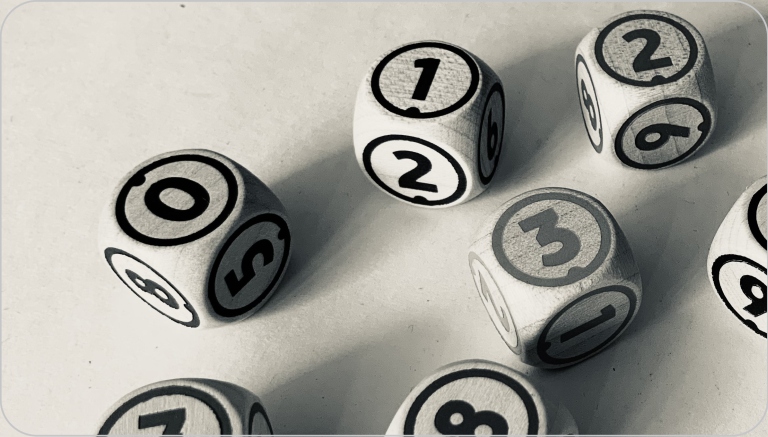
Dice
GetThe basic set contains 20 dice and is intended (ideally) for activities of one student. The wooden
dice have embossed colored numbers 0 - 9 (the die measures 19 x 19 mm) and each number is included
3 times in the set. The set of stones is stored in a cotton bag with a drawstring. The bag is
printed with the name of the tool and a ring. We recommend writing a numerical or alphabetical
sequence in the ring and pairing it with a list of students in the class so that each student is
responsible for the contents of the bag. This is worthwhile especially if the tool moves from
class to class. Teach children to check the dice before each activity.
For functional work in class according to the methodology, we recommend ordering a "Class set" for
15 or 30 students.
Usage: Dice are intended for both beginners and advanced users. They are useful for both individual and group use. Tips and ideas for games and work can be found in the Abaku Start methodology. Dice can be used, for example, for games in a desk for ideas like "create a spider" or "Abaku cluster or sequences" or "logical sequences".
Why should you work with dice? Dice are a suitable tool for physical and mental manipulation of numbers, which has proven effective in the youngest school years when working both independently and in pairs - groups of three. With the help of dice, the youngest children quickly get to know numbers and learn to manipulate them quickly (both figuratively and practically).
For older children, we use dice as a motivator, for moments of distraction, for riddles, tricks, games. You will surely come up with your own ideas on how to use the dice and if it works for you, we would be very happy if you would share your experience with us and describe it to us. We currently offer those that are well-tested.
Didactic tip: The child's engagement is more important than the result. Error is an inevitable consequence of arithmetic teaching and is not an error that needs to be recorded or evaluated.
Description / scheme of number distribution on dice.
First die - numbers 1-2-3-4-5-6
Second die - numbers 7-8-9-0-1-2
Third die - numbers 3-4-5-6-7-8
Fourth die - numbers 9-0-1-2-3-4
Fifth die - numbers 5-6-7-8-9-0
The second set of five dice is the same. The dice are distinguished by color and each set contains
two dice of each color.
Teach children to check the dice before each activity. It is advisable to have at least one set of
dice in the desk.
Games with dice:
1. Sequences
For the youngest school age.
Children build an ascending sequence from 0 to 9. They manipulate the dice, having to turn them over
and find the right number. It is advisable for children to use both hands and develop fine motor skills
symmetrically, especially for left-handed children (but also for right-handed children).
Give the instruction to build a descending sequence (from 9 to 0) and observe how everyone handles
this task. Whether they just flip the already completed sequence, rearrange it, or even start searching
for numbers from scratch. Even though this activity is intended for the youngest, try giving it to
older children as well at the beginning.
In ordering, we automatically follow the direction of organizing numbers from left to right and top
to bottom (unless the teacher explicitly specifies otherwise).
2. Differences
In this game, children primarily learn to manipulate and recognize individual dice. Secondarily, depending on the experience and age of the children, the teacher can incorporate counting into the manipulations. Children place dice according to the teacher's instructions in front of them, behind them, next to them, on top of each other, while following the teacher's instructions about how much the numbers on the dice differ and how many dice they should use and how.
3. Build like me
A student secretly assembles their own combination of dice and describes the placement of the dice to a classmate using prepositions like in front, behind, on, etc. At the end, both compare that their dice are placed the same. The activity is fundamentally the same as the previous one; children work in desks in pairs or in larger groups where one gives instructions and others build.
4. Basic sequences
Children mix the dice and without further rolling, build consecutive chains. If they have dice
with the same numbers, they use them to branch the sequence. In the chains, they follow the
direction of organizing numbers from left to right and top to bottom. We give this task to
individuals.
We point out the creation of a sequence even if some numbers are missing. So the sequence does not
copy the number line.
5. Triples
Children mix the dice and without further rolling, build organized groups of numbers. It is no
longer a question of free choice; children are limited by what numbers came up. Groups are formed
by two addends and their sum, or by a difference, minuend, and subtrahend. Even though the first
combinations are usually triples, we don't prevent children from creating combinations from
multi-digit numbers.
Again, we pay attention to the arrangement from left to right, or from top to bottom, so that the result
is on the right, or at the bottom. The task is quite challenging; it depends on luck what values the
dice show. However, it is always possible to assemble at least one example.
6. Simple multiples
Students work in pairs at the desk with one set of dice. One student rolls any die. The second
selects from the remaining dice, gives the selected die to the first student, and says which
number's multiple the first player should create. The first player leaves the first (rolled) die
untouched, doesn't turn it, but can rotate the given die freely and searches for the right number
so that the numbers on both dice form a multiple of the requested number.
For example: The number 2 comes up. One student selects multiples of seven and the second student looks
for number 1 (21) or 8 (28) or 4 (42) on the given die.
The activity is more suitable for multiples of lower numbers (up to five), which always have a solution.
For higher numbers, the task may not have a solution, but discovering and confirming this possibility
is also important for children.
7. Abaku cluster
A student rolls the dice and selects any three and builds a three-digit number from them (in the image 938). Next, among the remaining dice, they search for a die with a value corresponding to the absolute value of the difference between the values of the first and second die of the upper triple (|9-3|=6) and further the second and third die of the triple (|3-8|=5) and places them under the upper triple of dice. In the same way, they place one more die in the third row (creating the so-called difference cluster).
This activity is suitable for getting to know the concept of absolute value, where only the difference between the numbers matters. The concept of absolute value does not need to be introduced; we simply ask how much the numbers differ. Thanks to this, the position of zero is equal to other numbers; each row can have zero in the first position. The cluster can be created even with a base of four dice, but the task is more challenging and requires combining dice and swapping them to get the die with the required number. Children clearly prefer this variant. Since all ten dice are used here, the task may not always have a solution (probably, we have never recorded such a case yet).
8. Abaku spider
A student rolls all the dice and no longer turns them over in the next activity. They build groups of examples that connect to each other so that each number is a meaningful part of some example. The dice in one row connect to each other; individual examples can overlap. In the image, in the horizontal row, 2 + 8 = 10 and 10 – 4 = 6, in the vertical row 6 + 2 = 8 and 2 * 8 = 16. In both rows is also 2³ = 8. We insist that zero cannot be used as an independent number, so it also cannot be the result of an example. It can only be part of a multi-digit number (10, 20, 101…). Once the student has assembled all the dice, we ask them to read all the created examples aloud. This is excellent feedback and a correctness check. Children usually realize by themselves when reading aloud where they made a mistake. If they assembled correctly, we let them exchange dice in pairs without changing the assignment and let them assemble the dice that the classmate had before. It is usually a big surprise for them that there is a completely different set of examples from the same assignment.
9. 3x3 Abaku square
Children build a 3 x 3 square from dice so that all organized triples in the vertical and horizontal directions create examples of Abaku equations.
The task can be given with a restriction to addition and subtraction only (as in the image) or all operations can be allowed. The assignment is more of a puzzle and is more suitable for independent work. Children must realize that the required number may not be on the remaining die, but that some dice need to be swapped, examples changed, and thus arrive at the desired solution. The task can be modified by fixing some stones (center, corners, first row). In these cases, it is advisable to start with an already completed set so that the person giving the assignment can be sure that the task has a solution. For example, we can assign the requirement that the corners should have numbers 1, 7, 9, 3, because according to the image we know that the task is solvable.
10. Game "clean hands" (for 2 - 6 players, teams)
Each player or team has one set of dice (10 dice). Players first decide who will go first. Only then does each player grasp their dice in the palm of their hands and release them in front of them at the same time. After that, the dice cannot be turned over; they only arrange them in front of them so that both they and their opponents can see them. The player who starts plays the first equation from three dice. In subsequent turns, one to three dice can be played. A maximum of three dice can be played at once (for example 358), but in combination with dice played in previous turns, a player can create equations of any size (for example 61358) by adding one to three dice. Other players continue after them according to the rules of adding the Abaku game = dice must always connect to each other and each connection must form independently or as part of another Abaku equation (See Abaku game rules). The player or team that gets rid of their last die wins. When playing, players watch the dice of opponents that have not yet been played and try to add in a way that makes it difficult or even impossible for the next player to add a die. A player who cannot add a die has the option instead to rotate one of their unplayed dice to the desired position.
X. Your Game A game that you play with dice with your students, the students enjoy very much and is not described here and you want to tell other teachers about it. Join the team of methodology creators and send your ideas, please, to info@abaku.org. We will test it and be happy to share it here
Product description
Equipment - the "hand" set is supplied for each student in a drawstring bag and together in a bag
or portable backpack.
We manufacture the tools in the Czech Republic and they are made to be portable and serve in school
for years.
The basic "hand" set contains 10 original dice with colored digits 0 to 9
Technical parameters: Supplied in a cotton bag with print.
Product: beech, oak, hornbeam wood.
Die size: 19 mm
Print: Digits with color are embossed into the surface.
Surface: matte | Lifespan 3 - 10 years