Cards
Get NowThe basic set contains 22 cards and is intended (ideally) for activities of one student.
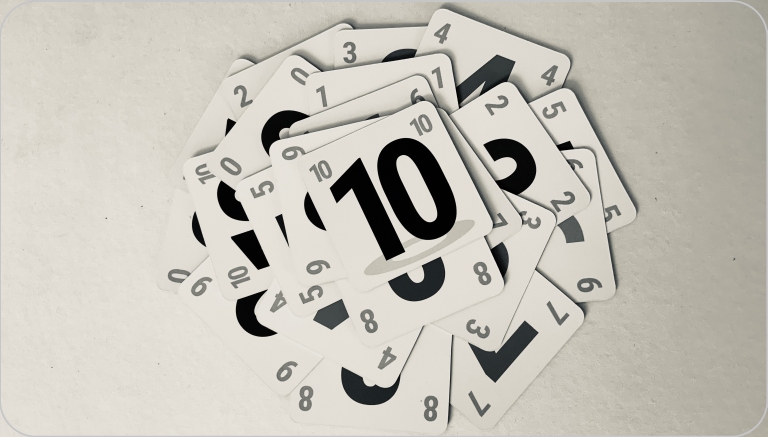
The cards are printed with colored numbers 0 – 10 (the card is 55 x 55 mm in size) and each number
is included twice in the set. The set of cards is stored in a cotton bag with a drawstring. The bag
is printed with the name of the tool and a ring. We recommend writing a number or alphabetical order
in the ring and pairing it with the list of students in the class so that each student is responsible
for the bag's contents. This is particularly worthwhile if the tool moves from class to class. Teach
children to check the cards before each activity.
For functional work in class according to the methodology, we recommend ordering a "Class set" for
15 or 30 students.
Uses:
Abaku cards are designed for both beginners and advanced learners. They are suitable for both individual
and group use. Tips and suggestions for play and work can be found here and in the Abaku Start methodology.
Why should you work with cards? Cards are a suitable tool for physical and mental manipulation of numbers, which in the youngest grades is proven to work both individually and in pairs or small groups. Through cards, the youngest children quickly become familiar with numbers and learn to manipulate them quickly (both figuratively and practically).
We recommend combining card games and dice games primarily in younger grades. For older grades, card games are suitable mainly for repetition, reinforcement of learned material, relaxation, or as a motivator for social education. The square shape of cards allows their use not only "in hand" but also for laying them out on a table and playing "memory" variants.
Didactic note: The child's interest is more important than the result. Mistakes are an inevitable consequence of teaching arithmetic and should not be recorded or evaluated as errors.
Editorial tip: For a short (5 minute) arithmetic practice at the beginning of class. The teacher gives the class a task (1+1=?) and students show the result using cards. The teacher has immediate feedback under control and dictates the pace and difficulty. The exercise is conducted briskly, playfully and cheerfully. Tasks should be such that both the weakest and strongest students are challenged. This warm-up has become very popular in classes where it has been implemented for some time.
Games with Cards
1. The Ten
The game is designed for children from the moment they learn their first mathematical operations. It is suitable for the whole class and can be played in pairs. It also interests older school children.
In the game we use cards 1-10 (we remove zeros from the deck). A larger number of cards is more suitable for more varied combinations of tasks.
The tournament variant of the game is played with 40 cards (4 x 10) with two players in ten rounds. Children sit together at a desk and one of them deals. They don't need a referee, they are able to agree and reach agreement.
The game develops mathematical skill in using all mathematical operations, both when introducing them, and when reinforcing and practicing them. It is very suitable when introducing powers and roots.
When introducing the game, it is appropriate to write numbers on the board and solve them together. From the list we select tasks that have multiple solutions. At the same time as finding a solution, we write it on the board as a single expression. The improvement of children with repeated play is very noticeable.
Learn to recognize when a task has no trivial solution, and in order to maintain the swift pace of the game, pull such a task after a while and lay out four more cards. We play the game at a shared table. The basic rule is that whoever speaks first and is speaking is not interrupted and is not drowned out. It is up to the teacher to decide who went first; in trivial examples it may be impossible to determine who was first. For correct and fastest solutions, we give one card from the laid out cards as a point counter. After the game, children count how many cards they have received and return them. The fact that the game really caught the children is also evident from the fact that they stop caring about the score, that for them the experience of the game itself is important. At the end of the game, they return the cards without counting how many they have. And they boast about lightning-fast solutions or creative combinations.
Time requirements for one game: The game consists of an arbitrary number of rounds, so it can be finished at any time. We recommend playing at the end of class, such as the last five minutes. A tournament of each against each with twenty children can be played in two hours.
Game Rules
The game requires at least 4 sets of numbers from one to ten. Children gather around a table. We shuffle
the deck of cards and lay four cards on the table. Players compose an equation from them. The laid
out numbers are combined using all mathematical operations (addition, multiplication, division, subtraction,
powers, roots, …), arbitrary regrouping and parentheses so that the result is always 10.
Even though the symbol two is not written for the second root, in the game it is necessary to "use" the card with the number two (specifically, from cards 2 and 9 we compose the square root of nine √9 = 3). The game is greatly simplified by using powers of 1n and anything to the power zero (n0). Initially, this helps children understand and absorb these powers. However, this then simplifies the game so much that children solve most equations only using these powers. Therefore, we do not recommend using powers 1n and anything to the power zero (n0).
The game has a total of 715 combinations, of which 3 have no solution (if we do not consider repeated use of trigonometric functions and their inverse functions as solutions). These are (1 6 6 7), (5 7 7 8) and (6 7 7 8). Attention! Not all possible quadruples of numbers have solutions in the field of basic operations.
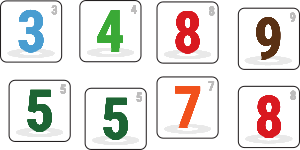
3 + 9 – 8 : 4 = 10. Each number is used exactly once.
Cards can be grouped into multi-digit numbers: 85 - 75 = 10
2. Modulo
The game is designed for children with knowledge of multiplication tables. We play in a group of four or more players. (The number of players is not limited in any way, especially if everyone plays fast enough.) With a larger number of children (whole class of 20 or more children), it is better to play with small groups (pairs, triplets). Generally, children prefer to play in small groups, advise each other and decide together.
Each player (i.e., even a possible group playing as one player) has a set of ten cards (1-10). The game practices multiples of the chosen number.
Time requirements for one game: The game takes 5-15 minutes, of course, the more experienced the players, the faster they play. We include it in the opening parts of the class.
Game Rules:
Each player has a set of cards in hand that they do not show to the other players. Players gradually
discard cards onto a pile, adding the value of the discarded card to the value of the pile.
Attention, cards cannot be discarded arbitrarily – the value of the pile must be a number that is not
divisible by three. A player who, by discarding a card (i.e., adding the card's value to the pile's
value), violates this rule, takes all the cards from the pile. These cards are not taken into hand,
they remain aside as a tally of penalty points. And the next player starts by discarding their card
to start a new pile. The game continues until all players get rid of their cards (i.e., ten rounds).
The winner is the one who took the fewest cards from the piles. The game becomes tense in the final
rounds, when players run out of cards and are then forced to play what they have in hand.
For younger players, a variant is possible where, after exceeding the ten-fold of the given number,
the ten-fold is subtracted from the pile value. If there is no suitable number among the cards, children
have no problem remembering it, they don't need to see the symbol of the starting number. Children
surprisingly prefer counting to higher multiples, without subtracting back. The game can be played
on any number and its multiples. Multiples of three turn out to be the most playable. For higher numbers,
it takes a long time to approach the next multiple and it can be skipped with just one card and then
nothing for a long time. Even numbers (multiples of two) are too frequent and very soon suitable numbers
run out and then players just take.
With multiples of three, you can use the divisibility rule for three (sum of digits) at higher numbers,
and children most easily discover counting with remainders. Usually they first discover the "safe cards"
– 3, 6 and 9, then they realize that they don't have to count the value of the pile, but just the remainder
when dividing by three. This skill is not necessarily the goal of the game. There are children who
will always count the full value. It doesn't diminish the benefit of the game.
First player discards a ten.
Second player adds a four. The value of the pile is thus 10 + 4 = 14
Third player adds an eight. The value of the pile is 14 + 8 = 22
Fourth player adds 5. And that is a mistake.
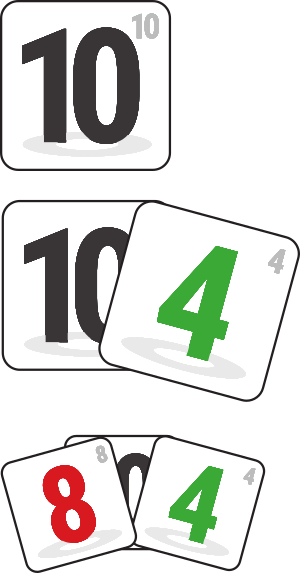
22 + 5 = 27, the pile value is divisible by three. The player takes all the cards, but sets them aside, doesn't take them into hand. He leaves his five on the pile and the next player continues.