Abaku Start
Alena Vávrová
GETTING STARTED / Create a Number
The following suggestions are based on the principles of the Abaku method and are designed for the
gradual development of children's arithmetic skills. They are not time-consuming and can therefore
be used for even just part of a lesson. Thorough knowledge of Abaku principles is not a necessary
condition, but it is a significant advantage if the teacher knows them.
All activities are consistent with the Framework Educational Plan and help achieve expected outcomes.
Specifically:
For Period 1: Reads, writes and compares natural numbers, performs simple arithmetic operations
with natural numbers from memory.
For Period 2: Uses commutativity and associativity of addition and multiplication in mental and written
calculations, solves and creates tasks where they apply learned arithmetic operations across natural
numbers, solves simple practical word problems and problems whose solutions are largely independent
of usual school mathematics procedures and algorithms.
For Period 3: Uses squares and square roots in calculations, formulates and solves real situations
using equations and their systems, analyzes and solves simple problems, uses logical reasoning and
combinatorial judgment when solving tasks and problems, finds various solutions to presented or examined
situations.
If you don't have Abaku experience, start with the Create a Number exercise.
Don't be afraid to offer activities primarily designed for younger children to older children as well.
Use "very simple" examples according to them to weaken aversion to arithmetic, create a comfortable
start for more complex activities and then for the game itself.
The basic exercise "Create a Number" contains several activities to introduce the Abaku principle,
all suitable for complete beginners. The indicated age of children is only approximate, based on
what children should be able to do according to the Framework Educational Plan. It is not in any
way an upper limit of usability. In the Triples and Quadruples exercises, you can teach children
to create examples without operation symbols and equals signs and to read the example "hidden" in
three- and four-digit numbers. It's worth intertwining these activities with suggestions from the
town of Plusville.
Among children across different grades, chains are very popular, and searching for examples in chains
of numbers. You have three different difficulty levels of chains available, and of course solutions
are included. The last exercise introduces powers and roots along with multiplication and division.
See how easily third graders work with squares and square roots.
CREATE an Abaku number (tool CARDS, MAGNETS, STONES)
Topic: Filling in numbers to create an arithmetic equality example (without written mathematical
symbols).
Goal (expected output): Creating combinations, finding further solutions.
Typical age group: 6-7 years.
Instructions: We give children two numbers (Abaku cards). The way to give them is arbitrary: write
on the board or show on a card, but it is appropriate for children to see the numbers. The task is
to fill in a third number so that the numbers can form an example after adding operation symbols.

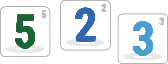
For example, for the given numbers 2 and 5 you can add 7 and get the example 2 + 5 = 7 (we write 257) or add 3 and get the example 5 − 2 = 3 (we write 523).

For children who know the multiplication table, the number 10 also appears, because 2 · 5 = 10 (we
write 2510). If someone suggests the number 25, because 5 squared = 25, use this to introduce the
concept of powers (see the Powers and Roots activity). If you have already discussed this topic,
try to lead them to the combination 25 (two to the fifth), thus completing the number 32.
Caution: In purely Abaku combinations, powers using the number two or three are not written and higher
powers are not used. Don't let this limit you right now and let children complete pairs of numbers
arbitrarily. It's up to you what limitations you set. The important thing is that children can find
and locate multiple solutions for any given pair of numbers.


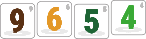
For reference: I fill in 3 (9 − 6 = 3) or 15 (9 + 6 = 15) or 54 (9 · 6 = 54)



For reference: I fill in 4 (7 − 3 = 4) or 10 (7 + 3 = 10) or 21 (7 · 3 = 21).




For reference: I fill in 4 (8 − 4 = 4) or 12 (8 + 4 = 12) or 32 (8 · 4 = 32) or 2 (8 : 4 = 2).
Create your own examples with multi-digit numbers. Write the resulting triples (quadruples…) as one
number without operation symbols and without equals signs.
TRIPLES and QUADRUPLES (tool STONES, CARDS, DICE)
Topic: Creating examples of addition and subtraction in the range up to ten, creating examples
using the multiplication table.
Goal (expected output): Teach children to "see" an example in a triple (quadruple) of numbers without
written symbols, practice counting and creating examples, improve fine motor skills by manipulating
small objects.
Typical age group: 6-7 years (1st grade), second part 9 years (end of 2nd, beginning of 3rd grade).
Instructions: For this activity, we need stones with individual digits (including zero) so that each
set has each digit at least 3 times. Children spread the digits on a desk and create triples so that
after adding operation symbols, an example is formed. Look at the picture. We read the created triple
718 as "7 + 1 = 8", the triple 936 as "9 − 3 = 6".


We follow the order number – operation symbol – number – equals sign – result number. Examples are read consistently from left to right (or top to bottom). Point to any triple on the desk and have the child read the example. Watch out for scrambled numbers, for example 374. The child may see in it that 3 = 7 − 4, but we insist on the order mentioned above.
1. Specify the first digit. Other children select from the bag and line them up in a column below each other, then fill in the digits for the example. Children quite naturally quickly exceed ten. Don't stop them, just keep watching for correct arrangement. Show that when they reverse the order of stones in the created triple, they get an example with the opposite operation (e.g., 549 / 5 + 4 = 9 and 945 / 9 − 4 = 5).


2. Specify the result (in this arrangement the last number of the triple) and children create examples that have that result. For example, for the number 8 they complete 3 + 5, so the resulting form is 358.



3. Children spread the digits on a desk and create quadruples so that after adding operation symbols, an example is formed. Look at the picture. We read the created quadruple 5735 as 5 · 7 = 35.
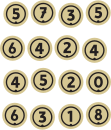
4. Other variants can specify the first or second digit or the result and fill in the remaining digits. We can insist that groups of stones must be only four digits. For example, line up ten twos on the desk in a small column and have children fill in examples so that the two is in the first place. Notice and prominently praise those who, besides the examples 2918 (2 · 9 = 18) or 2714 (2 · 7 = 14), come up with the example 2874 (28 : 7 = 4).
5. Take an example – a quadruple of stones (digits) and create four different examples, variants
of the original example. For example:
7321 (7 · 3 = 21)
3721 (3 · 7 = 21)
2137 (21 : 3 = 7)
2173 (21 : 7 = 3)


6. Guide children to search for such a quadruple of digits that can form multiple examples, for example, the numbers 2348 (basic example 3 · 8 = 24, second example 4 · 8 = 32). Appreciate the beauty of mathematics with the children.
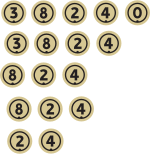
38 + 2 = 40 / 3 · 8 = 24 / 8 : 2 = 4 / cube root of 8 = 2 / 2 squared = 4
7. Announce a competition for who can build the most examples within a time limit. You can require
examples only in multiplication or division. Estimate the time limit based on the children's
speed. Even if children need several minutes to put together ten examples at first, they will
improve very quickly. It's better to have a few competitions with shorter time than one long one.
You have an immediate overview of how each child is working, because the assembled examples and their
quantity are visible directly on the desk.
SPROUTS
Topic: Creating examples. (tool Magnets / board - chalk, chalk, paper-pencil, stones)
Goal (expected output): Combines numbers to create an Abaku number.
Typical age group: No limitation.
Instructions: We write the same Abaku number one below the other in a column and create a basic stem.
Each row can be developed into a longer Abaku number. For younger children, we choose gradual growth
of the plant with simpler calculations. For example:
3263261
9003261226
326192
78326
32632626
29326
6523262
326193
15326127
… 326 : 326 = 1
… 900 + 326 = 1226
… 32 · 6 = 192
… 78 : 3 = 26
… 32 – 6 = 26
… 29 – 3 = 26
… 652 : 326 = 2
… 32 + 61 = 93
… 153 – 26 = 127
Children most often take the basic number as a whole and we need to gently guide them not to be afraid to split the digits of the original number into individual members of the example or into the result. Working together at the board is motivating and children compete in creating more complex examples.
CHAIN (tool Magnets / board - chalk, chalk, paper-pencil, stones)
Topic: Creating chains of examples and conversely finding examples in chains of numbers.
Goal (expected output): Teach children to "see" an example in a group of numbers without written symbols.
Typical age group: Everyone.
Instructions: We build on the Triples and Quadruples and Create an Abaku number activities. It is good
to start the lesson by using elements from these activities, that is, putting together triples, filling
in numbers. From the triples created on the desk, we try to create a chain with children so that the
first and last number of the triple overlap. Look at the picture:
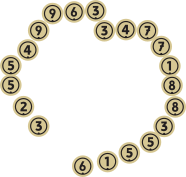
If we connect the connecting numbers into one (we put them on top of each other), a chain is
formed 325496347183516. In reverse, we can go through the chain and say the examples from which
the chain is made.
Try to divide the chain into individual examples. We are given the numbers 4593617 and we search for
examples in them so that the individual examples are linked in a chain.
Look at the picture:
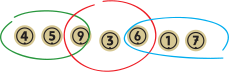
This is the example 4 + 5 = 9 in the green eye, 9 − 3 = 6 in the red eye, and 6 + 1 = 7 in the blue chain eye.
ABAKU CHAINS A: (tool Magnets / board - chalk, chalk, paper-pencil, stones)
Use the working sheet Chain A / found in the methodology. These are single-digit examples (that
is, addition and subtraction in the range up to ten).
Write (project) one chain on the board for children and let them gradually mark (circle) and write
down examples. Teach them to use multiple colors for clarity. Don't be satisfied with just marking
and write out the examples. You can give the more skilled children the entire worksheet right away.
Notice that sometimes two numbers are used in the next example and sometimes just one. Create your
own chain. Since we are still sticking to single-digit numbers in both the task and the result, you
need to be careful of certain combinations. This is mainly some arrangements with nine, for example
9817 (indeed 9 − 8 = 1 and 8 − 1 = 7, but also 9 + 8 = 17), 9716, 9615, etc., and still 1358 (13 −
5 = 8 and 3 + 5 = 8). These are nice combinations and we'll use them later.
Overview of the Chain A worksheet offer:
1 + 2 = 3 / 3 + 5 = 8 / 8 − 6 = 2 / 4 + 5 = 9 / 9 − 6 = 3 / 3 + 4 = 7 / 7 − 2 = 5 / 2 + 3 = 5 / 6 − 2 = 4 / 6 − 3 = 3
2 5 7 1 6 3 9 1 8 3 5 1 4 2 2 7 9
2 + 5 = 7 / 7 − 1 = 6 / 6 + 3 = 9 / 9 − 1 = 8 / 8 − 3 = 5 / 5 − 1 = 4 / 4 − 2 = 2 / 2 + 7 = 9
3 5 8 1 7 1 6 1 5 3 2 1 8 9 3 6
3 + 5 = 8 / 8 − 1 = 7 / 7 − 1 = 6 / 6 − 1 = 5 / 5 − 3 = 2 / 1 + 8 = 9 / 9 − 3 = 6 / 3 − 2 = 1
4 3 7 2 5 1 4 5 9 2 7 6 1 5 3 8
4 + 3 = 7 / 7 − 2 = 5 / 5 − 1 = 4 / 4 + 5 = 9 / 9 − 2 = 7 / 7 − 6 = 1 / 5 + 3 = 8 / 1 + 4 = 5 / 6 − 1 = 5
5 2 3 3 6 9 5 4 2 2 6 8 4 4 3 1
5 − 2 = 3 / 3 + 3 = 6 / 9 − 5 = 4 / 4 − 2 = 2 / 2 + 6 = 8 / 8 − 4 = 4 / 4 − 3 = 1 / 3 + 6 = 9
6 3 9 2 7 4 3 1 4 5 9 8 1 6 7
6 + 3 = 9 / 9 − 2 = 7 / 7 − 4 = 3 / 3 + 1 = 4 / 4 + 5 = 9 / 9 − 8 = 1 / 1 + 6 = 7 / 4 − 3 = 1 / 1 + 4 = 5
7 1 8 4 4 3 7 2 9 3 6 1 5 1 4 3 7
7 + 1 = 8 / 8 − 4 = 4 / 4 + 3 = 7 / 7 + 2 = 9 / 9 − 3 = 6 / 6 − 1 = 5 / 5 − 1 = 4 / 4 + 3 = 7
8 1 9 6 3 3 2 5 7 6 1 1 2 6 8 5 3
8 + 1 = 9 / 9 − 6 = 3 / 3 + 2 = 5 / 7 − 6 = 1 / 1 + 1 = 2 / 2 + 6 = 8 / 8 − 5 = 3 / 6 − 3 = 3 / 2 + 5 = 7
9 5 4 3 1 1 2 4 6 2 8 1 9 7 2 2 4
9 − 5 = 4 / 4 − 3 = 1 / 1 + 1 = 2 / 2 + 4 = 6 / 6 + 2 = 8 / 8 + 1 = 9 / 9 − 7 = 2 / 2 + 2 = 4
Caution: In the 5th row there is also an example 6954 (6 · 9 = 54) and in the 6th row 3927 (3 · 9 = 27) and 27431 (27 + 4 = 31). If one of the children figures this out, praise them; if not, don't push it. Working with children, we find that there are more and more hidden examples there. The previous sentence applies.
ABAKU CHAINS B: (tool Magnets / board - chalk, chalk, paper-pencil, stones)
Use the working sheet Chain B / found in the methodology. Each chain contains approximately 10
examples, mainly in addition and subtraction of two-digit numbers, with several of them being
single-digit (see previous chains). Children will find these examples quickly, especially if they
have some experience from the previous activity. Wait a moment and give weaker students a chance
first.
Give one chain as homework once you've done several chains and children understand what's expected.
Add a chain to a written test – it works as a rescue example. Everyone will find something in it.
Circle (mark with different colors) the examples in the chain so you can see the chain is not broken.
Write down individual examples so you have better control of what you already have. When creating your
own chains, pay attention to the interconnection. In the solution, notice how the individual examples
intertwine.
Overview of the Chain B worksheet offer:
13 + 5 = 8 / 8 − 7 = 1 / 7 − 6 = 1 / 13 + 19 = 32 / 3 + 2 = 5 / 3 + 5 = 8 / 71 + 5 = 76 / 7 + 6 = 13 / 19 + 32 = 51
2 1 3 4 5 5 1 0 1 5 6 9 8 4 9 4 5
2 + 1 = 3 / 1 + 3 = 4 / 5 + 5 = 10 / 1 + 5 = 6 / 15 + 69 = 84 / 9 − 4 = 5 / 21 + 34 = 55 / 5 + 10 = 15 / 15 − 6 = 9 / 98 − 4 = 94
3 6 9 2 7 9 6 4 2 6 6 1 2 1 8 1 3
3 + 6 = 9 / 9 − 2 = 7 / 2 + 7 = 9 / 6 − 4 = 2 / 6 + 6 = 12 / 21 − 8 = 13 / 36 − 9 = 27 / 64 + 2 = 66 / 6 + 12 = 18 / 69 + 27 = 96
4 5 9 3 6 2 3 1 4 3 7 5 0 5 7 1 2
4 + 5 = 9 / 9 − 3 = 6 / 3 + 1 = 4 / 4 + 3 = 7 / 5 + 7 = 12 / 45 − 9 = 36 / 23 + 14 = 37 / 43 + 7 = 50 / 93 − 62 = 31 / 7 + 50 = 57
5 3 8 6 1 8 5 3 7 1 0 2 7 9 8 1
5 + 3 = 8 / 8 − 5 = 3 / 3 + 7 = 10 / 2 + 7 = 9 / 9 − 8 = 1 / 53 + 8 = 61 / 61 − 8 = 53 / 37 − 10 = 27 / 2 + 79 = 81 / 18 + 53 = 71
6 3 9 5 4 9 3 4 6 4 0 3 4 3 7 7 1 4
6 + 3 = 9 / 9 − 5 = 4 / 5 + 4 = 9 / 34 + 6 = 40 / 40 + 3 = 43 / 4 + 3 = 7 / 7 + 7 = 14 / 63 − 9 = 54 / 49 − 3 = 46 / 34 + 37 = 71 / 39 + 54 = 93
7 4 3 1 4 3 5 8 2 7 8 5 1 3 4 8
7 − 4 = 3 / 4 − 3 = 1 / 3 + 1 = 4 / 3 + 5 = 8 / 8 + 5 = 13 / 1 + 3 = 4 / 74 − 31 = 43 / 35 − 8 = 27 / 51 − 3 = 48 / 31 + 4 = 35 / 58 + 27 = 85
8 7 1 5 6 9 6 5 1 1 2 1 3 2 4 6
8 − 7 = 1 / 1 + 5 = 6 / 6 − 5 = 1 / 1 + 1 = 2 / 2 + 1 = 3 / 2 + 4 = 6 / 8 + 7 = 15 / 15 − 6 = 9 / 6 + 5 = 11 / 11 + 21 = 32 / 56 + 9 = 65 / 11 + 2 = 13
9 2 7 4 3 1 2 3 5 4 9 4 5 9 9 1 8
9 − 2 = 7 / 7 − 4 = 3 / 3 − 1 = 2 / 2 + 3 = 5 / 4 + 5 = 9 / 9 − 1 = 8 / 4 − 3 = 1 / 1 + 2 = 3 / 5 + 4 = 9 / 27 + 4 = 31 / 31 + 23 = 54 / 54 − 9 = 54 / 94 + 5 = 99 / 9 + 9 = 18 / 9 − 1 = 8
Note: Despite all efforts, division examples have appeared in individual chains, specifically in
the 2nd example 551 (5 : 5 = 1), 4th example 623 (6 : 2 = 3), 6th example 771 (7 : 7 = 1) and 9th
example 991 (9 : 9 = 1).
All chains contain powers and roots. When you get to them (see the Powers and Roots section), return
to the chains and try to find them. If children (or you) discover other examples in the chain, praise
them (you are praised).
ABAKU CHAINS C: (tool Magnets / board - chalk, chalk, paper-pencil, stones)
Use the working sheet Chain C / found in the methodology. These are not just single-digit or two-digit examples of addition and subtraction, but we use all operations.
Overview of the Chain C worksheet offer:
1 + 5 = 6 / 56 + 90 = 146 / 6 · 8 = 48 / 92 + 9 = 101 / 15 − 6 = 9 / 14 · 6 = 84 / 84 + 8 = 92 / 89 + 2 = 91 / 15 · 6 = 90
2 4 6 4 8 8 6 1 4 8 4 3 2 8 6 2
2 + 4 = 6 / 64 : 8 = 8 / 8 + 6 = 14 / 8 · 4 = 32 / 8 − 6 = 2 / 24 : 6 = 4 / 6 · 14 = 84 / 43 · 2 = 86 / 2 + 46 = 48 / 24 + 64 = 88
3 8 2 4 0 4 2 6 1 6 4 4 8 3 2 4
3 · 8 = 24 / 8 : 2 = 4 / 4 + 2 = 6 / 6 : 1 = 6 / 4 + 4 = 8 / 8 · 3 = 24 / 38 + 2 = 40 / 2 + 40 = 42 / 16 : 4 = 4 / 4 · 8 = 32 / 82 − 40 = 42
4 2 6 7 3 3 1 0 0 6 3 3 1 3 2 0
4 + 2 = 6 / 67 + 33 = 100 / 6 − 3 = 3 / 3 : 3 = 1 / 3 · 1 = 3 / 42 : 6 = 7 / 733 − 100 = 633 / 33 − 1 = 32 / 26 + 7 = 33 / 33 − 13 = 20
5 6 7 8 9 7 2 9 5 4 5 4 9 7 7 1
56 : 7 = 8 / 8 · 9 = 72 / 7 + 2 = 9 / 9 − 5 = 4 / 5 + 4 = 9 / 7 : 7 = 1 / 9 − 7 = 2 / 9 · 5 = 45 / 49 : 7 = 7 / 97 − 2 = 95 / 54 − 5 = 49
6 6 3 6 9 4 5 9 9 8 1 9 9 2 8
6 · 6 = 36 / 3 + 6 = 9 / 9 − 4 = 5 / 4 + 5 = 9 / 9 − 8 = 1 / 8 + 1 = 9 / 1 · 9 = 9 / 36 : 9 = 4 / 94 + 5 = 99 / 9 · 9 = 81 / 81 : 9 = 9 / 36 + 9 = 45 / 98 + 1 = 99 / 19 + 9 = 28
7 3 2 1 9 4 2 3 6 9 2 7 1 4 4 1
7 · 3 = 21 / 3 + 2 = 1 / 19 + 4 = 23 / 2 · 3 = 6 / 3 + 6 = 9 / 9 − 2 = 7 / 1 · 4 = 4 / 4 : 4 = 1 / 73 + 21 = 94 / 36 − 9 = 27 / 2 · 7 = 14 / 27 + 14 = 41
Notice the digits 2 and 7 – they appear in three examples and each time in a different position: in one example, two is the subtrahend and seven is the result, in the next example, both numbers are multiplied together, and finally they form one number. Try to find other such interesting groups with the children.
8 6 4 8 1 3 4 4 7 3 7 2 1 4 5 8
8 · 6 = 48 / 1 + 3 = 4 / 73 − 72 = 1 / 1 + 4 = 5 / 86 + 48 = 134 / 44 − 7 = 37 / 3 · 7 = 21 / 72 −
14 = 58 / 81 − 34 = 47 / 7 · 2 = 14
9 8 1 7 2 9 4 6 2 4 4 9 6 1 5 5
9 − 8 = 1 / 7 + 2 = 9 / 6 − 2 = 4 / 1 · 5 = 5 / 9 + 8 = 17 / 17 + 29 = 46 / 4 · 6 = 24 / 24 · 4 = 96
/ 9 + 6 = 15 / 9 · 81 = 729 / 46 − 2 = 44
Put numbers close to each other and they become a magnetic x magical building kit - look at the chain 4972981990:
7 + 2 = 9 / 9 – 7 = 2 / 98 + 1 = 99 / 1 · 9 = 9 / 72 : 9 = 8 / 81 : 9 = 9 / 72 + 9 = 81 / 81 + 9 = 90 / 729 : 81 = 9 / 8 + 1 = 9 / 497 − 298 = 199 / 9 cubed = 729,...
Working with chains practices all mathematical operations, does not allow children to stay in just one operation, forces them to combine digits and create suitable numbers. And despite all this, they are amazed by it. Watch the videos on our website. Specifically the first two parts about Abaku chains. Stop the video at the very beginning and examine the given chain. Try to find hidden examples and guess how the children will proceed. Then play the video.
Notice the increasing difficulty of the examples found. This is no accident, your children will
reach this conclusion through repeated solving. Weaker students get to use the initial examples,
participate with the others and experience their own success.
TIP from the editorial team :) Abaku chain as a warm-up. Once a teacher works through several chains
with children and they understand the principle of finding examples, you can involve children in creating
chains. Students come up with their own chains (each at their own level) and write them on paper with
their name. They hand the papers to the teacher. At the beginning of each lesson, the teacher randomly
selects one of the papers. The selected student writes their chain on the board and moderates the class
search for examples themselves. The teacher gets about 2-4 minutes to record attendance, check attendance,
etc. Children get warmed up for arithmetic. Each student knows that someday it will be their turn;
all students look forward to the activity.
BALLS (tool Worksheets Balls 1 / Balls 2)
Topic: Reading three-digit numbers, comparing and classifying them from various perspectives,
finding examples. Goal (expected output): Create a playful relationship with numbers in children,
so that when they look at them, they can not only read them but also find a hidden example in
them. Over time, that example will not be hidden for children; they will see it at first glance.
Typical age group: 6 years old (addition and subtraction of single-digit numbers), 8 years old (3rd
grade on three-digit numbers).
Instructions: We use Balls 1 or Balls 2 and write in - print - use numbers
/ examples (variations) as you wish.
- If working with first graders, we look for balls that have an example hidden in their number. The
example contains one mathematical operation and an equals sign, always in that order. We call such
balls (and numbers) Abaku. For example, a ball with the number 347 is Abaku because it contains the
example 3 + 4 = 7; a ball with the number 374 is not Abaku because it does not have the example in
the required order.
- Where we introduce three-digit numbers and children learn to read them correctly, we start by having
children read the numbers on the balls, they can compare and arrange them by size. If you haven't used
this sheet to find examples yet, use it now.
- Children read the numbers on the balls and immediately say whether they are Abaku (from Plusville
1), color the Abaku balls and distinguish balls with addition examples from those with subtraction
examples by color.
- Prepare combinations of three numbers that do not contain any examples - but so that by changing
one number, an example can already be formed. Fix one digit to make the ball Abaku. Compare with the
children how far they agreed on the corrections. Emphasize and appreciate the variety of corrections.
For example, the ball 141 is not Abaku and can be corrected to 541, 145, 111, 441 or 144. Of course,
the children's knowledge plays a role (whether they already know the multiplication table).
On blank balls we write Abaku numbers, or draw additional balls.
- Ask the question, how many three-digit Abaku numbers are there? (This problem is addressed in more
detail in the Problem Tasks exercise / License Plates).
With younger children, we ask questions like which Abaku numbers start with one, two…, what is the
smallest Abaku number (112; if we work with zero, then of course 101).
Let them think about whether Abaku numbers can be one-digit or two-digit. Depending on the level of
the children, we can ask the question the other way, that is, why one-digit or two-digit numbers cannot
be Abaku.
Notes:
- If you have already met the town of Plusville in any activity, you can use the designation that the
balls are from Plusville.
- The Abaku method uses zero only as part of a multi-digit number, never on its own. For these balls,
I would recommend its usual use.
- It may happen that among the children the knowledge appears that, for example, the number 39 is Abaku
because 3 squared is 9. Yes, in that case it can be Abaku even a two-digit number – we praise.
POWERS AND ROOTS
Topic: Squares and square roots.
Goal (expected output): Creating an idea of repeated multiplication and its notation as a power, introducing
a root as the opposite operation to a power. Application of repeated multiplication to power calculation.
Typical age group: 10 years old (3rd grade) and older.
Instructions: Powers and roots usually appear in mathematics curriculum in 8th grade of elementary
school. However, children are capable of mastering the actual concept of powers as repeated multiplication
right after they learn the multiplication table. Examples where both factors are the same usually interest
them at first sight. Many of them rhyme beautifully, you certainly know:
"3 · 3 is nine, only grumpy bears complain",
"5 · 5 is twenty five, around the world we'll fly" or
"6 · 6 is thirty six, a hundred six more kicks".
At this point, this is just about introducing the concept. We will call multiplying two (three) identical factors a squared (cubed) power. Take advantage of children's interest and introduce power in general as repeated multiplication.
1. Focus on the power of two, because multiplying two is not difficult and children can handle it,
or they can even use adding two identical numbers one below the other.
Tell children the Indian legend of Sissa ben Dahir, who reportedly invented chess. He showed his king
that even a small pawn (ordinary people) could decide the victory. The wise scholar Sissa ben Dahir
then wished for a small thing as a reward for his game: for the king to give him grains of wheat in
such a quantity that on the first square of the chessboard he would place one grain, on the second
two, on the third four, on the fourth eight, and on all the next ones always twice as many grains as
on the previous square. Try to calculate with the children how many grains that was.
For reference: There are 64 squares on a chessboard, the number of grains doubles on each successive
one, which means "times two" – repeated multiplication by two, on the last square then 263. "On 63" because although there are 64 squares, the multiplying steps, moving to the next
square, are 63.
So 263 = 92,233,720,368,547,758,08, all grains added together is 18,446,744,093,709,551,615.
Even if you don't calculate all the way to the final result, it is a surprise for children how quickly
the number of grains grows, and the resulting number is unimaginable to them.
2. We introduce the root as the opposite operation to power. Just as addition and subtraction,
multiplication and division form pairs. "The square root of 49 is 7, because 7 squared is 49."
Children will almost certainly come up with roots of numbers that are not perfect squares of natural
numbers. From the small multiplication table they know that not all numbers divide evenly (so they
are not multiples of natural numbers).
So there are numbers that don't have integer roots. A calculator can be used to determine them. Select
numbers with children in the range up to 100 that can be rooted, that is, are squares of natural numbers.
Do children want to find other numbers? Support them in that.
3. Show children how to correctly write a power (most children know the superscript from computer
text editors) and how to write a root. It will certainly interest them how this sign originated.
(Originally, the word radix (root) was written before the number to be rooted. So something like
this: "radix(64) = 8". Gradually it was shortened to just r, for example "r(81) = 9", and in the
form of a small r you can already see the basis for the root sign √.)
Along with knowledge of the multiplication table, children can square (and root) up to ten. Through
use in Abaku examples, they will learn some cubed powers and roots, gradually adding some squares of
larger numbers. It is not necessary to teach (drill) this.
4. The Abaku notation of a number assumes only squared and cubed powers and roots without the use of any other symbols, just like other examples. Specifically?
√648 we read as "the square root of 64 is 8".
63216 we read as "6 cubed is 216".
³√273 we read as "the cube root of 27 is 3".

5. We show children that a series of examples with powers is in Abaku form quite beautiful and
hides other examples in it:
73343 is 7 cubed = 343 and 7 − 3 = 4.
³√2166 is cube root of 216 = 6 and 1 · 6 = 6.
³√1255 is cube root of 125 = 5 and square root of 25 = 5.
One of the most beautiful Abaku examples: 93729 is 9 cubed = 729, 97 + 2 = 99, 9 + 7 =
2, cube root of 729 = 9, 7 + 2 = 9.
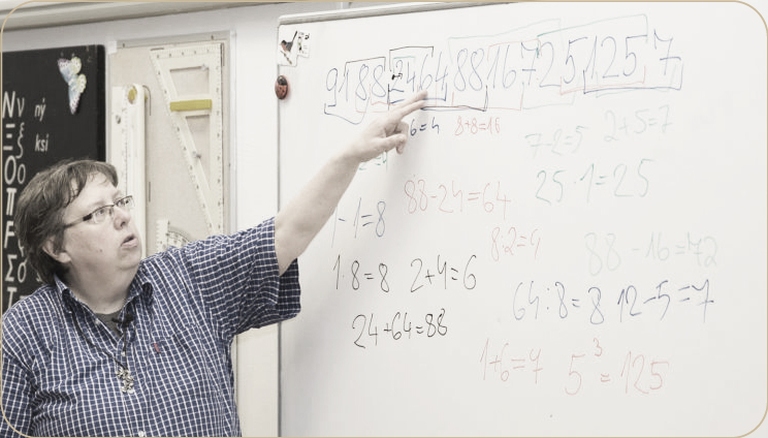
The Abaku number 2464 you may already know from cars in Plusville. Notice that it hides
two other examples in it (for reference 2 squared = 4 and 4 cubed = 64).
6. Other possible inspiration in the Plusville methodology / Transportation and Streets or in the
Combo / Abaku and Logical Chains section.
Other suggestions for specific offers of further game activities can be found by clicking on the individual
tools, which are didactically linked with the methodology practice.
Other suggestions for specific offers of further game activities can be found by clicking on the individual tools, which are didactically linked with the methodology practice.